


CBCT Scan Center in Powai: 3D Dental Imaging Explained
A regular dental X-ray shows your teeth and jaw as a flat picture. For many treatments that is enough. But when a surgeon needs to know exactly how wide the bone is, where a nerve runs, or how close a wisdom tooth sits to the jaw canal, a flat image can hide important details.
A CBCT scan solves this by giving a three-dimensional view. This page explains what CBCT scanning in Powai is, when it is useful, how safe it is, what the scan involves, and what it costs, so you know whether you actually need one.
What Is a CBCT Scan?
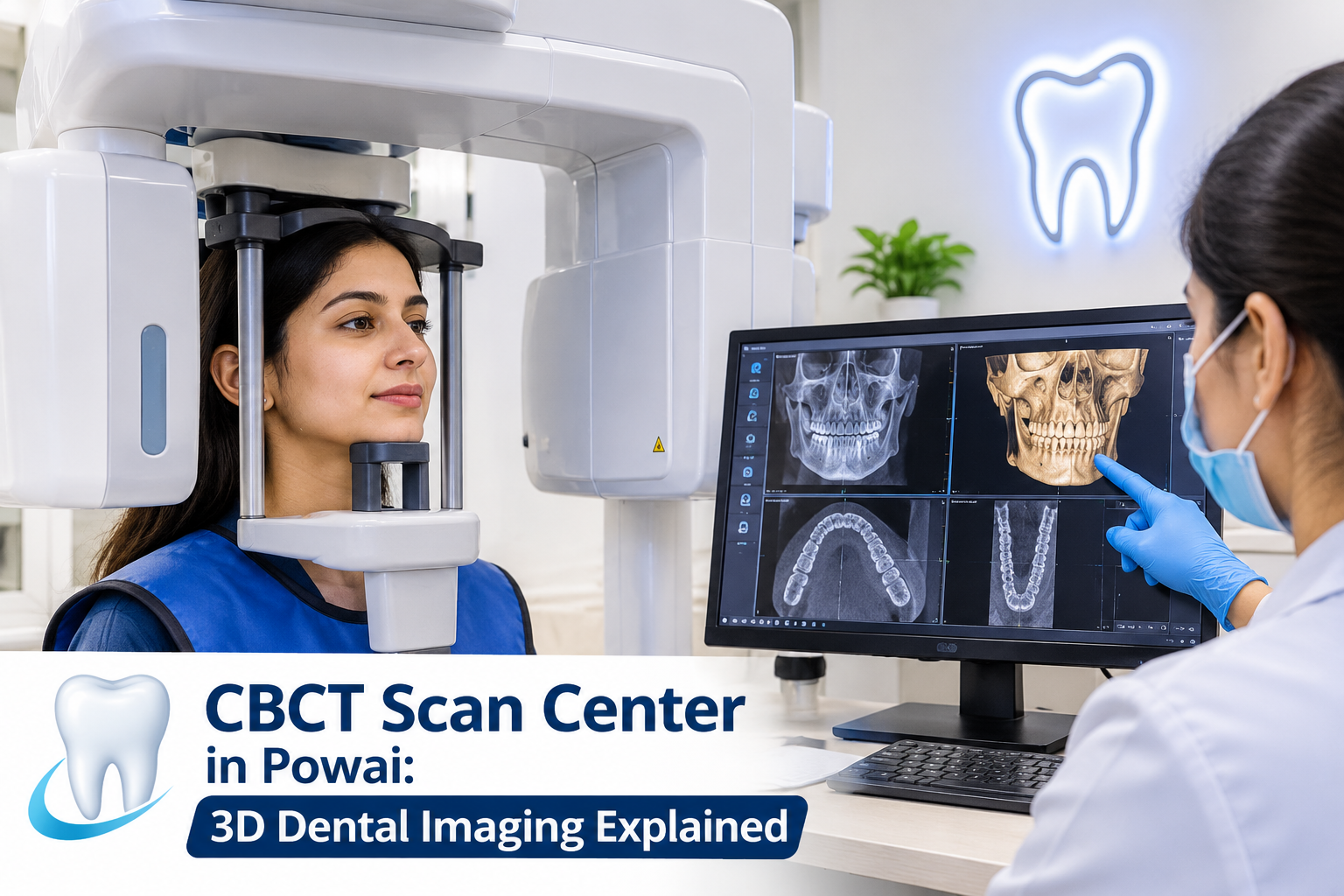
CBCT stands for Cone Beam Computed Tomography. The scanner rotates once around your head, taking many images in a few seconds. Software combines them into a 3D model of your teeth, jawbones, nerve canals, and sinuses.
Your dentist can then view the area from any angle or slice through it, and measure bone height, width, and density accurately. It is a dental-specific scan, different from a hospital CT scanner.
CBCT vs Regular Dental X-Ray
| Periapical / OPG X-ray | CBCT Scan | |
|---|---|---|
| Image | Flat, 2D | 3D, viewable from any angle |
| Shows bone width | No | Yes |
| Shows nerve canal position | Limited | Clear |
| Best for | Cavities, routine checks, overall view | Surgery and complex planning |
| Radiation | Lower | Higher than a single X-ray, depends on scan size |
| Used routinely | Yes | Only when needed |
A CBCT does not replace routine X-rays. It is an extra tool for cases where 3D information changes the treatment plan.
When Is a CBCT Scan Useful?
Dental implant planning
Shows bone width and height, the position of the nerve in the lower jaw, and the sinus floor in the upper jaw, helping choose the implant size and decide whether grafting is needed.
Impacted wisdom teeth
Shows how close the roots are to the jaw nerve, which helps plan a safer removal.
Root canal problems
Helps in complex cases such as missed or calcified canals, suspected root fractures, or failed treatment where a flat X-ray is unclear.
Cysts and jaw lesions
Shows the size and position of a lesion and its relation to nearby structures.
Impacted canines and orthodontic planning
Locates buried teeth and shows their relation to the roots of neighbouring teeth.
Jaw joint (TMJ) assessment
Shows the bony surfaces of the joint in selected cases.
Bone grafting and surgical planning
Measures the amount of bone loss and helps plan the procedure.
When You Probably Do Not Need One
- Routine checkups and cavity detection
- Simple fillings and scaling
- Straightforward extractions of visible teeth
- Most simple root canals on teeth with clear anatomy
A responsible clinic recommends CBCT only when it will change the plan or improve safety, not for every patient.
Is a CBCT Scan Safe? Understanding Radiation
CBCT uses X-rays, so it involves radiation. The dose depends on the machine, the settings, and the size of the area scanned. A small-area scan focused on one region delivers less than a large scan of both jaws. Doses are generally much lower than a medical CT scan, but higher than a single dental X-ray.
How good clinics keep exposure low
- Recommending the scan only when it is clinically useful
- Choosing the smallest field of view that covers the problem
- Using suitable settings, with extra care for children
- Not repeating scans unnecessarily
Tell your dentist if you are pregnant or may be pregnant. Scans are normally avoided or postponed unless clearly necessary. Children are scanned only when there is a clear clinical reason.
What Happens During a CBCT Scan?
- Preparation. You remove earrings, necklaces, glasses, and removable dental appliances. No fasting or injection is needed.
- Positioning. You stand or sit while the head is gently supported to keep it still. You may bite lightly on a small guide.
- Scan. The machine rotates around your head once. The scan itself takes under a minute, and you feel nothing.
- Review. The 3D images appear on screen within minutes, and your dentist explains what they show.
The entire visit usually takes about 10 to 15 minutes. It is open and does not involve a closed tube.
What Your Dentist Looks For in the Scan
- Bone height and width at the planned implant site
- Position of the lower jaw nerve and its distance from the site
- Sinus floor position in the upper jaw
- Bone density and quality
- Root shape and position of neighbouring teeth
- Presence of cysts, infection, or other changes
- Position of impacted teeth
This detail lets the dentist choose the right treatment and avoid surprises during surgery.
CBCT Scan Cost in Powai
| Scan Type | Approximate Cost |
|---|---|
| Small field of view (one area) | ₹2,000 – ₹4,000 |
| Medium field of view (one jaw) | ₹3,000 – ₹6,000 |
| Large field of view (both jaws) | ₹5,000 – ₹10,000 |
These are approximate ranges and vary by clinic, machine, and scan size. Confirm the current price when booking, and ask whether the report and a copy of the scan are included.
Questions worth asking
- Is the scan done in-house or at an outside imaging centre?
- Who reads and reports the scan?
- Will I receive a digital copy for my records?
- Is the charge adjusted if I proceed with treatment at the same clinic?
How to Book a CBCT Scan
Call or WhatsApp Dental Surgeons Planet on [insert number]. Tell the team why you need the scan, for example implant planning or a wisdom tooth. If you have a referral note or an earlier X-ray, bring it. Mention if you are pregnant, and carry any previous scans you have.
Why Choose Dental Surgeons Planet
- Scans recommended only when they help your treatment
- Findings explained on screen in plain language
- Integration with implant, extraction, and root canal planning under one roof
- Written estimate before treatment begins
- Convenient for Hiranandani, Chandivali, Kanjurmarg, and Vikhroli residents
FAQs
1. What is a CBCT scan in dentistry?
It is a 3D X-ray scan of the teeth and jaws that shows bone, nerves, and roots in detail.
2. Is CBCT better than a regular X-ray?
It is more detailed for surgical and complex cases, but not needed for routine checks. Each has its role.
3. Is a CBCT scan painful?
No. It is non-invasive and takes under a minute.
4. How much does a CBCT scan cost in Powai?
Roughly ₹2,000 to ₹10,000 depending on the scan size and clinic.
5. Do I need a CBCT scan before a dental implant?
It is strongly recommended in most cases because it shows bone and nerve positions in 3D. Your dentist will explain if it is needed for you.
6. Is the radiation harmful?
The dose is low for a single, justified scan, but it is not zero. That is why scans are done only when useful and with the smallest suitable area.
7. Can children or pregnant women have a CBCT?
Only when clearly necessary. Tell your dentist beforehand so the safest option can be chosen.
8. How long does the scan take?
The scan takes under a minute, and the full visit is about 10 to 15 minutes.
9. Can I take the scan to another dentist?
Usually yes. Ask for a digital copy of the scan data.
10. Do I need a referral?
Not necessarily. You can book directly if your dentist or you feel it is needed.
Conclusion
A CBCT scan is a precise planning tool, not a routine requirement. Used at the right time, it makes implants, wisdom tooth surgery, and complex root canals safer and more predictable. Used unnecessarily, it adds cost and radiation without benefit.
If you have been advised a 3D scan, Dental Surgeons Planet in Powai can explain why it is needed, show you the findings, and use them to plan your treatment.
Book your scan or consultation today.