


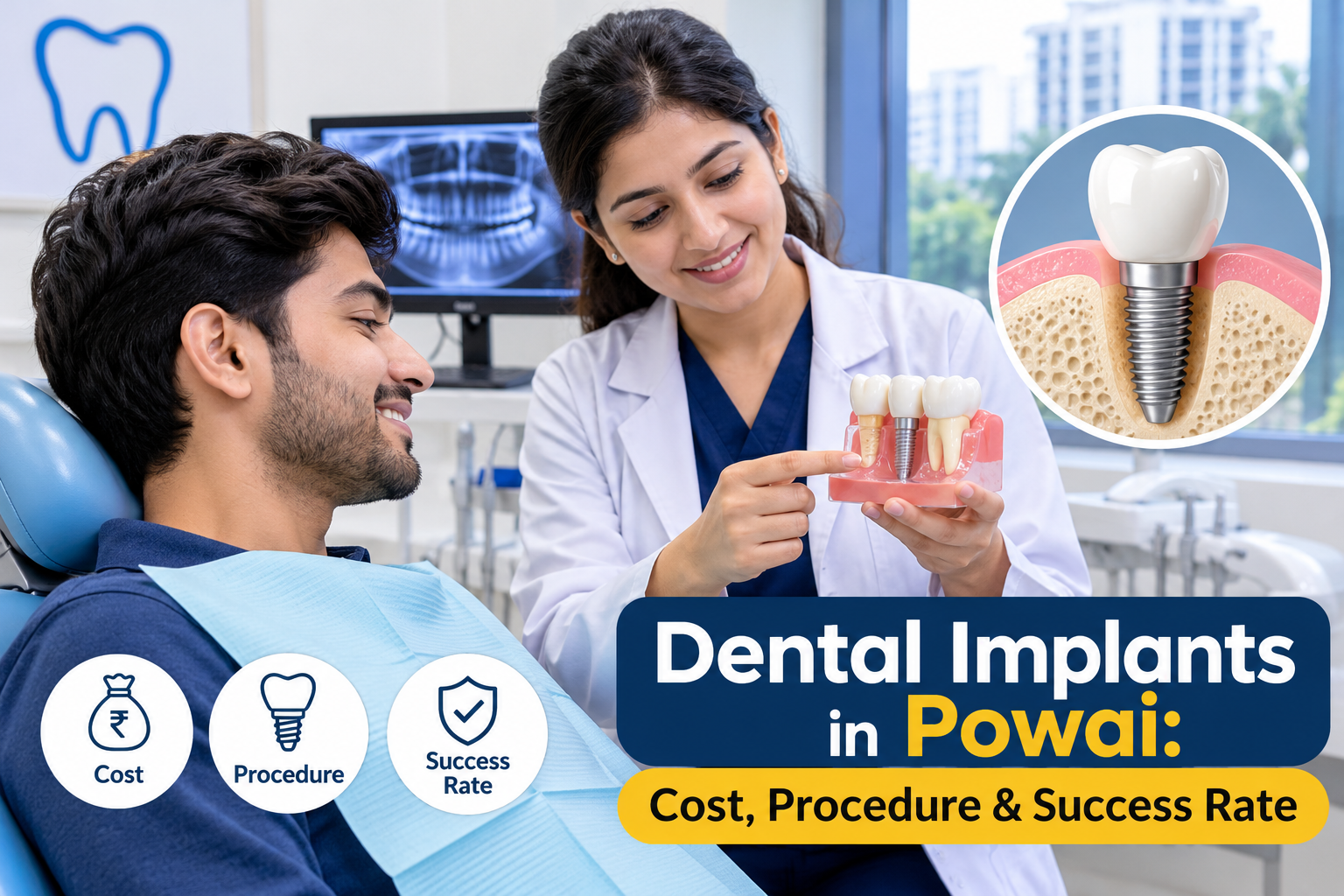
Dental Implants in Powai: Cost, Procedure & Success Rate
Losing a tooth affects more than your smile. Chewing becomes harder, neighbouring teeth begin to drift, and the jawbone under the gap slowly shrinks. Many people in Powai live with a gap for years because they are unsure what the options are, what implants cost, or whether the procedure is safe.
Dental implants in Powai are the most complete way to replace a missing tooth, because they replace the root as well as the crown. This page explains who is suitable, how the procedure works, the timeline, the cost, and what the success rate really means, so you can decide with clear information.
What Is a Dental Implant?
A dental implant is a small titanium post placed in the jawbone to act as an artificial tooth root. Over a few months, the bone bonds with the titanium, a process called osseointegration. A connector (abutment) and a ceramic crown are then fixed on top.
The result is a fixed tooth that you brush and bite with like a natural one. Because the implant sits in the bone, it also helps preserve the jawbone, which a bridge or denture does not.
Implant Options
Single tooth implant
Replaces one missing tooth without grinding down the neighbouring teeth.
Implant-supported bridge
Two or more implants support a bridge that replaces several teeth in a row.
Implant-supported denture
A removable denture that clips onto a few implants, giving much better stability than a conventional denture.
Full arch solutions (such as All-on-4)
A fixed set of teeth supported by a small number of implants for patients missing most or all teeth in an arch. Suitability depends on bone and gum health.
Who Is Suitable for Dental Implants?
Usually good candidates
- Adults with a missing tooth or teeth and a fully grown jaw
- Healthy gums with no active gum disease
- Enough bone, or a bone that can be built up with grafting
- Good oral hygiene and willingness to attend follow-ups
Needs careful assessment first
- Diabetes that is not well controlled
- Smoking or tobacco use, which raises the risk of failure
- Active gum disease, which must be treated first
- Heavy grinding of teeth
- Conditions or medicines that affect bone healing
Suitability is decided only after examination and imaging. If implants are not right for you, your dentist should explain why and suggest an alternative.
The Implant Procedure Step by Step
1. Consultation and imaging
Examination, digital X-rays, and where needed a 3D CBCT scan to measure bone width, height, and the position of nerves and sinuses.
2. Treatment plan and estimate
The implant size, position, and any extra procedures are planned, and you receive a written estimate.
3. Treating other problems first
Gum disease, infections, or decay are treated before surgery.
4. Extraction and grafting, if required
If a tooth must be removed, the site may be allowed to heal first, or in suitable cases an implant is placed at the same time. If bone is thin, a graft may be advised.
5. Implant placement
Done under local anaesthesia. Many patients find it more comfortable than they expected. Sedation can be discussed for anxious patients.
6. Healing
The implant bonds with the bone over about 2 to 4 months, sometimes longer after grafting.
7. Abutment and crown
Once healed, the abutment and custom crown are fitted and adjusted to your bite.
Timeline
| Stage | Typical Time |
|---|---|
| Consultation, imaging, planning | 1 to 2 visits |
| Healing after extraction or grafting (if needed) | 2 to 6 months |
| Implant placement | One visit |
| Healing and bonding | About 2 to 4 months |
| Crown fitting | 1 to 2 visits |
| Overall | Often 3 to 6 months, longer if grafting is needed |
Some suitable cases allow a temporary tooth the same day. Your dentist will tell you what is possible for you.
Dental Implant Success Rate: What It Really Means
You will see success rates quoted online, often in the range of 90 to 98 percent in published studies over 10 years or more. These figures are averages from research and depend heavily on the patient and the clinic.
Factors that improve outcomes
- Good bone and healthy gums
- Careful planning, ideally with 3D imaging
- Non-smoking and controlled diabetes
- Excellent home cleaning and regular checkups
- Using a night guard if you grind your teeth
Factors that raise the risk of failure
- Smoking and tobacco
- Poor oral hygiene and untreated gum disease
- Uncontrolled diabetes
- Skipping follow-up visits
No clinic can guarantee a specific outcome for an individual patient. A responsible dentist will explain your personal risk factors rather than quote a single impressive number.
Aftercare and Recovery
First 2 to 3 days: Mild swelling and soreness are normal. Take medicines as prescribed, use cold compresses early on, and eat soft, lukewarm food.
First week: Keep the area clean with gentle brushing and the rinse your dentist advises. Avoid smoking and heavy exercise in the first days.
Long term:
- Brush twice daily and clean between teeth daily
- Visit for scaling and checkups every 6 months
- Do not ignore bleeding or swelling around an implant, as gum infection around implants can cause bone loss
Contact the clinic if pain increases after the first few days, swelling worsens, or the implant feels loose.
Dental Implants vs Bridge vs Denture
| Implant | Bridge | Denture | |
|---|---|---|---|
| Replaces root | Yes | No | No |
| Protects jawbone | Yes | No | No |
| Needs neighbouring teeth ground | No | Yes | Sometimes (clasps) |
| Surgery needed | Yes | No | No |
| Upfront cost | Highest | Medium | Lowest |
| Typical lifespan | Often 15+ years with care | About 10 to 15 years | About 5 to 8 years |
Bridges and dentures are valid choices when implants are not suitable or the budget is limited. The right option depends on your bone, health, and priorities.
Dental Implant Cost in Powai
| Treatment | Approximate Cost |
|---|---|
| Consultation and examination | ₹300 – ₹1,000 |
| CBCT scan | ₹2,000 – ₹10,000 |
| Single tooth implant with crown | ₹25,000 – ₹60,000 |
| Implant-supported bridge | ₹70,000 – ₹1,50,000 |
| Implant-supported denture | ₹60,000 – ₹1,20,000 |
| Full arch fixed solution (per arch) | ₹1,50,000 – ₹3,50,000 |
| Bone grafting (if needed) | ₹8,000 – ₹25,000 |
These are approximate ranges. The final cost depends on the implant system, crown material, bone condition, and any extra procedures. You receive a written estimate after examination.
What affects the price
- Implant brand and system
- Crown material (ceramic or zirconia)
- Need for grafting or sinus lift
- Number of implants
- Extractions or gum treatment required beforehand
Ask what is included: the implant, abutment, crown, and follow-up visits. A very low quote may leave out some of these.
How to Choose an Implant Clinic in Powai
- Ask who will place the implant and what their training and experience are
- Check that 3D imaging is used for planning
- Ask about the implant brand and warranty terms in writing
- Expect a written plan covering every stage and cost
- Ask how complications and follow-ups are handled
- Be cautious of pressure to decide quickly or of unusually low prices
Why Dental Surgeons Planet for Dental Implants in Powai
- Implant planning with clear examination and imaging
- Pre-implant care, including gum treatment and extractions, under one roof
- Options from a single implant to full arch solutions
- Written estimate before any treatment begins
- Convenient for Hiranandani, Chandivali, Kanjurmarg, and Vikhroli residents
FAQs
1. Are dental implants painful?
The procedure is done under local anaesthesia and is usually comfortable. Soreness for a few days afterwards is normal and manageable.
2. How long do dental implants last?
With good care, many last 15 years or more, and often decades. The crown may need replacing sooner because of wear.
3. How much does a dental implant cost in Powai?
A single implant with crown is roughly ₹25,000 to ₹60,000. Grafting and other procedures add to this. You get an exact written estimate after examination.
4. How long does the whole process take?
Often 3 to 6 months, and longer if bone grafting is needed.
5. Can I get an implant if I have diabetes?
Possibly, if your blood sugar is well controlled. Your dentist may coordinate with your physician.
6. What if I do not have enough bone?
Bone grafting can often rebuild it before implant placement, depending on the case.
7. Can implants fail?
Yes, though it is uncommon. Smoking, gum infection, poor hygiene, and uncontrolled diabetes raise the risk. Early problems are usually manageable if caught in time.
8. Is the same-day tooth possible?
In selected cases, a temporary tooth can be fitted the same day. Many cases need healing first.
9. Do I need a CBCT scan?
For most implant cases it is strongly advised, because it shows bone and nerve positions in 3D. Your dentist will explain whether it is needed for you.
10. How do I book an implant consultation?
Call or WhatsApp Dental Surgeons Planet on [insert number] and mention that you want an implant assessment.
Conclusion
A dental implant is a long-term investment, and the best results come from careful planning, a healthy mouth, and good aftercare rather than speed or the lowest price. Understanding who is suitable, how the process works, and what affects success lets you ask the right questions.
For dental implants in Powai, Dental Surgeons Planet offers a clear assessment, imaging-based planning, and a written estimate before any treatment begins.
Book your implant consultation today and find out which option suits your bone, health, and budget.