


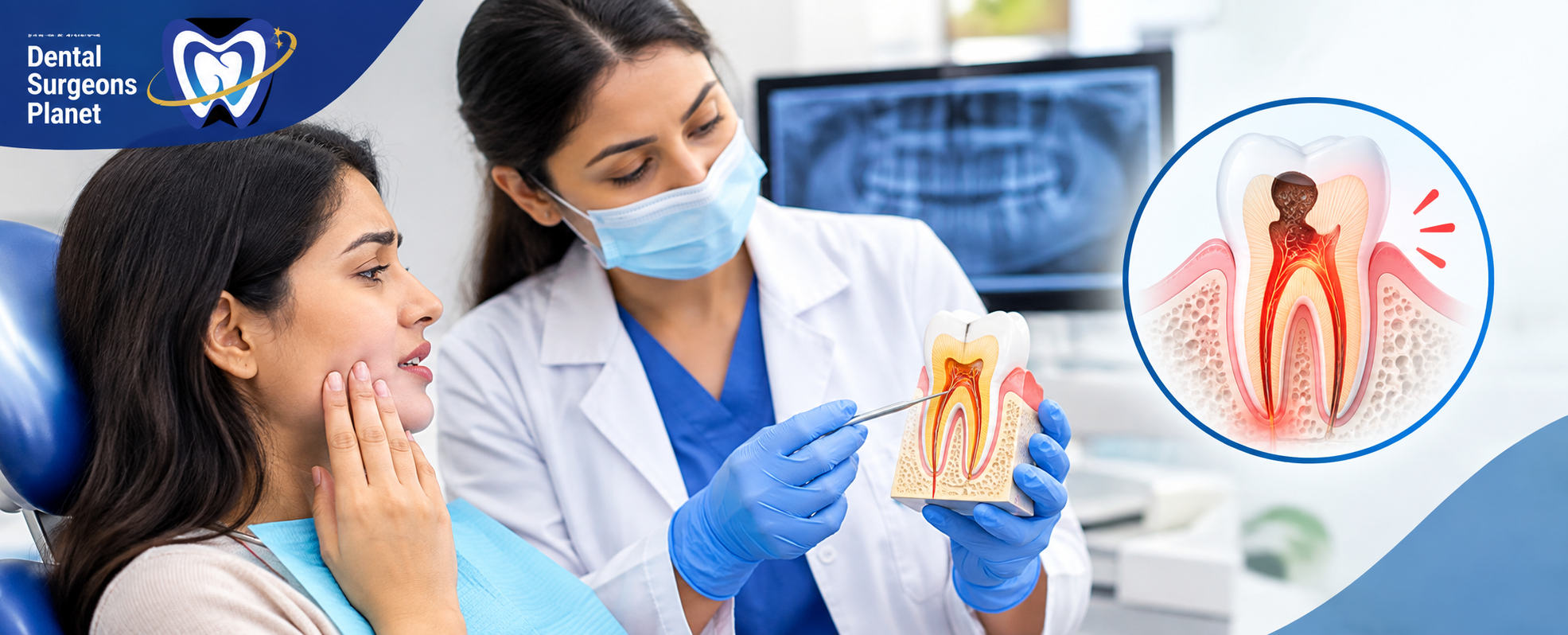
Do You Need a Root Canal? 10 Symptoms, Treatment Process, Cost & Recovery Guide
You have had a toothache for three days. Some days it is manageable — a dull background ache you can mostly ignore. Other days it wakes you at 3 AM and no painkiller touches it properly. You have been telling yourself it will go away.
It will not.
A toothache that persists beyond 48 hours is your tooth sending a signal that something is wrong inside — and that signal does not stop until the problem is treated. The question most patients in Powai and Mumbai ask at this point is the same one every person with a bad toothache eventually searches for:
Do I actually need a root canal?
The honest answer is — it depends on what is happening inside your tooth. Not every toothache needs a root canal. Some need a filling. Some need a crown. Some need extraction. And some genuinely need root canal treatment — and trying to manage them with painkillers while waiting to find out is allowing an infection to spread into surrounding bone and tissue that did not have to be involved.
This guide gives you the complete picture — 10 specific symptoms that indicate root canal treatment may be necessary, the complete treatment process explained step by step, an honest cost breakdown for Powai Mumbai, and a realistic recovery guide so you know exactly what to expect after treatment.
Read this. Then book the appointment you have been putting off.
What Is Root Canal Treatment and Why Is It Needed?
Before covering symptoms, understanding what root canal treatment does — and why it becomes necessary — makes the symptom list significantly more meaningful.
Every tooth has an outer layer of enamel, a middle layer of dentin, and an innermost space called the pulp chamber — containing the tooth's nerve, blood vessels, and connective tissue. This pulp extends down through the roots of the tooth in narrow channels called root canals.
When tooth decay is caught early, a filling removes the decay and seals the tooth — the pulp is never reached and the tooth remains alive and healthy. But when decay progresses unchecked — or when a tooth is cracked, damaged by trauma, or has had repeated dental procedures — bacteria eventually reach and infect the pulp.
Once the pulp is infected, it cannot heal itself. The infection causes the intense, persistent pain that characterises a tooth that needs root canal treatment. Left untreated, the infection spreads through the root tip into the surrounding bone — forming an abscess, destroying bone, and potentially spreading to adjacent teeth and beyond.
Root canal treatment removes the infected pulp entirely, cleans and disinfects the canal system, and seals it permanently — eliminating the infection source and saving the natural tooth. The tooth no longer has a living pulp but remains functional, anchored in bone, and with a crown placed afterward — indistinguishable from a natural tooth in normal function.
10 Symptoms That Suggest You May Need a Root Canal
These symptoms are listed in order of clinical significance — from the most definitive indicators to the supporting signs that, combined with others, point toward pulp infection requiring treatment.
Symptom 1 — Severe, Persistent Toothache That Will Not Go Away
This is the most common and most definitive symptom. A toothache from a cavity or cracked tooth is typically sharp and triggered by specific stimuli — biting, temperature, sweet foods. A toothache from pulp infection is different in character. It is deep, throbbing, and persistent — present without any trigger, worsening at night when you lie down and blood pressure increases to the head, and not adequately controlled by standard over-the-counter painkillers.
The pain may radiate — from the tooth into the jaw, ear, temple, or neck on the same side — making it difficult to identify exactly which tooth is causing it. This radiation pattern is characteristic of dental pain involving the nerve and is one of the clearest indicators that the pulp is involved.
If you have been waking at night from tooth pain for more than two consecutive nights — you almost certainly need professional assessment and very likely need root canal treatment.
Symptom 2 — Prolonged Sensitivity to Hot and Cold That Lingers
Normal teeth experience brief sensitivity to temperature — a cold drink causes a moment of sharp sensation that disappears within a second or two when the stimulus is removed. This is normal and does not indicate pulp involvement.
What indicates pulp damage or infection is sensitivity that lingers — temperature-triggered pain that persists for 30 seconds, a minute, or longer after the hot or cold stimulus has been removed. This prolonged response indicates that the nerve inside the tooth is inflamed and hyperresponsive — a condition called irreversible pulpitis that does not resolve without treatment.
Sensitivity specifically to heat — where hot food or drinks cause pain that is actually relieved by cold water — is a particularly strong indicator of advanced pulp infection. Most routine tooth sensitivity is worse with cold. When heat triggers intense pain that cold water soothes, the pulp is very likely necrotic or severely infected.
Symptom 3 — Spontaneous Pain With No Obvious Trigger
You are sitting at your desk, not eating, not drinking, not doing anything to stimulate the tooth — and it starts hurting. Suddenly. Without warning. For no apparent reason.
Spontaneous pain — pain that starts without any external trigger — indicates that the nerve inside the tooth is generating pain signals on its own. This happens when inflammation inside the closed pulp chamber reaches a critical level or when bacterial infection has damaged the nerve sufficiently that it fires without provocation.
Spontaneous pain is not something that resolves without treatment. It means the pulp is no longer functioning normally and the condition is past the point where conservative measures can reverse it.
Symptom 4 — A Small Pimple or Bump on the Gum Near a Tooth
If you notice a small raised bump — sometimes described as a pimple, blister, or bubble — on the gum tissue near a specific tooth, this is a sinus tract. It is not a gum pimple from poor hygiene. It is the exit point of a chronic infection draining from the root tip of an infected tooth through the bone and gum tissue to the surface.
A sinus tract means the infection inside the tooth has been present long enough to create a drainage channel through the surrounding bone. It may come and go — appearing when infection pressure builds and disappearing temporarily as it drains — and it may be painful or entirely painless.
A painless sinus tract is not reassuring. It simply means the chronic infection has found a drainage route that prevents acute abscess formation. The infection source — the infected pulp — is still present and is still destroying bone around the root tip.
A sinus tract near a tooth is essentially a definitive sign of pulp necrosis requiring root canal treatment or extraction.
Symptom 5 — Darkening or Discolouration of a Single Tooth
When a tooth turns noticeably darker than surrounding teeth — grey, brown, or dull yellow compared to adjacent natural teeth — it is almost always a sign of internal changes. A tooth that has suffered trauma, even years earlier, can develop necrosis of the pulp as a delayed consequence. As the pulp degenerates, breakdown products stain the dentine from within.
Tooth discolouration from intrinsic causes — originating inside the tooth — looks different from surface staining from tea, coffee, or tobacco. Surface staining affects multiple teeth and is distributed on the outer enamel surface. Internal discolouration affects a single tooth and creates a deeper, more uniform darkening that does not respond to whitening treatment.
A single noticeably darker tooth — particularly one that has been previously traumatised or that has had multiple large fillings — should always be assessed for pulp vitality before any cosmetic treatment is planned.
Symptom 6 — Swelling in the Gum, Face, or Jaw
Swelling is the body's visible indicator that infection has spread beyond the tooth itself. When a tooth's pulp infection progresses through the root tip into the surrounding bone, the immune response creates inflammation in the surrounding tissue — which presents as swelling.
Localised gum swelling near a specific tooth is the earliest and least concerning form. Facial swelling — a visibly swollen cheek or jaw — indicates the infection has spread into the soft tissue spaces of the face and represents a dental emergency requiring same-day care.
Any swelling accompanied by fever, difficulty opening the mouth, or difficulty swallowing is a medical emergency — not merely a dental urgency. Dental infections spreading into the deep spaces of the neck can compromise the airway and require hospitalisation.
Swelling is the symptom that most clearly communicates urgency. When a patient presents at Dental Surgeons Planet Powai with facial swelling alongside tooth pain, same-day treatment begins.
Symptom 7 — Severe Pain When Biting or Chewing
Some degree of biting sensitivity accompanies many dental problems — including cavities and cracked teeth. What specifically suggests pulp involvement or periapical infection is severe pain on biting that is disproportionate to what you would expect from the external appearance of the tooth.
When infection spreads from the root tip into the periodontal ligament — the thin cushioning tissue around the root — even gentle occlusal pressure causes intense pain because the inflamed ligament has no room to cushion the force. Patients with this presentation often describe being unable to bring their teeth together on that side at all.
Pain on biting that is this severe — where even the pressure of upper and lower teeth touching lightly is acutely painful — almost always indicates periapical involvement and typically requires root canal treatment or extraction to resolve.
Symptom 8 — A Cracked Tooth That Hurts When You Release Bite Pressure
This symptom pattern is specific to cracked tooth syndrome — a crack in the tooth that is not always visible on X-ray but creates a very characteristic clinical picture.
The pain happens not when you bite down but when you release the bite — a sharp, momentary electric pain as the two halves of the cracked tooth spring apart. This rebound pain on release is the clinical hallmark of a significant crack that is stressing the pulp with every chewing cycle.
If left untreated, a cracked tooth progresses. The crack extends toward the root. Eventually it reaches the pulp, causing infection. At this stage, a crown combined with root canal treatment may still save the tooth. Once the crack extends below the gum line and into the root, the tooth typically cannot be saved.
The window for intervention — crown placement before the crack reaches the pulp — is what the release-pain symptom represents. Do not ignore it.
Symptom 9 — Prolonged Bad Taste or Bad Breath From a Specific Area
A persistent bad taste coming from a specific area of the mouth — particularly if it recurs even after thorough brushing and is localised to one region rather than generalised — can indicate a draining dental abscess.
The bad taste is the taste of pus — the drainage from an infected tooth root that is finding its way through a sinus tract to the mouth. This is different from generalised bad breath from poor hygiene, dry mouth, or gum disease. It is specific, localised, and often accompanies the sinus tract described in Symptom 4.
Patients often notice this more first thing in the morning when overnight drainage accumulates. If you consistently notice a bad taste from a specific area despite maintaining good oral hygiene — this warrants urgent dental assessment.
Symptom 10 — A Tooth That Previously Had Multiple Large Fillings
This is a risk-factor symptom rather than an acute symptom — but it is one of the most reliable predictors of eventual pulp involvement seen at dental clinics in Powai Mumbai.
Every time a tooth is accessed for a filling — particularly large fillings in back teeth — the procedure generates heat, vibration, and proximity to the pulp that cumulatively stresses the pulp tissue. A tooth that has had three or four large fillings placed over its lifetime has been exposed to repeated pulpal stress. Eventually, some of these teeth develop pulp degeneration — slowly, without acute symptoms, until the pulp dies and periapical infection develops.
If you have a heavily filled tooth that starts showing any of the other symptoms on this list — even mildly — prioritise assessment sooner rather than later. The history of multiple fillings in the same tooth changes the threshold at which investigation is warranted.
How Is It Confirmed That You Need a Root Canal? — Clinical Diagnosis
Symptoms point toward the need for root canal treatment. Diagnosis confirms it. Here is how a dentist or endodontist at a dental clinic in Powai Mumbai confirms pulp involvement before treatment begins:
Clinical examination
The dentist assesses pain location, reproduction of symptoms with pressure and percussion testing, gum condition, and visual examination for sinus tracts, swelling, or discolouration.
Pulp vitality testing
A cold stimulus — typically an ice stick or refrigerant spray — is applied to the tooth. A normal tooth feels cold briefly. A tooth with irreversible pulpitis feels cold intensely and the sensation lingers. A tooth with necrotic pulp feels nothing — the nerve is already dead.
Electric pulp testing measures the electrical threshold at which a tooth's nerve responds. A necrotic tooth shows no response.
Periapical X-ray
Shows the root canal anatomy, surrounding bone condition, and any periapical pathology — a darkening around the root tip indicating bone destruction from chronic infection. A clear periapical X-ray does not rule out pulp disease — very early infections may not show bone changes yet — but significant periapical pathology on X-ray essentially confirms the diagnosis.
CBCT scan (for complex cases)
When the X-ray is inconclusive, when complex canal anatomy is suspected, or when periapical pathology needs three-dimensional assessment, a CBCT provides the additional diagnostic information needed.
Root Canal Treatment Process — Complete Step-by-Step Guide
Understanding exactly what happens during root canal treatment removes most of the fear that makes patients delay necessary treatment.
Step 1 — Local anaesthesia and comfort preparation
A topical anaesthetic gel is applied to the gum before any injection — numbing the surface so the needle is minimally felt. Local anaesthetic is then injected slowly and precisely into the tissue adjacent to the tooth. Within 3 to 5 minutes the tooth and surrounding area are completely numb.
Your endodontist will confirm complete numbness by tapping and pressing on the tooth before beginning. If you feel anything beyond pressure during the procedure, raising your hand stops treatment immediately and additional anaesthetic is administered. A good endodontist in Powai Mumbai will never proceed through discomfort.
Step 2 — Rubber dam placement
A thin rubber sheet called a dental dam is placed around the tooth being treated. It isolates the tooth from saliva, keeps the working area sterile, prevents irrigating solutions from entering the mouth, and maintains a clean operating field throughout treatment. It feels like a rubber frame around the tooth — not uncomfortable, quickly forgotten once treatment is underway.
Step 3 — Access opening
Using a dental handpiece, a small opening is made through the crown of the tooth — through the enamel and dentin — to access the pulp chamber beneath. Because the area is completely numb, no pain is felt. You hear and feel the vibration of the handpiece.
Step 4 — Pulp removal and canal negotiation
The infected pulp tissue is removed from the pulp chamber and the entrance to each root canal is located. Very fine, flexible instruments — endodontic files — are introduced into each canal to confirm patency and begin shaping.
At this point your endodontist uses an apex locator — an electronic device that measures the exact length of each canal by detecting the change in electrical resistance at the root apex. This provides the working length for each canal — the measurement to which cleaning and shaping are performed — with precision that X-ray estimation cannot match.
Step 5 — Rotary canal cleaning and shaping
Motorised rotary endodontic files — flexible nickel-titanium instruments driven by a torque-controlled handpiece — are used to progressively clean and shape each canal from the access opening to the apex. These instruments remove infected dentine from the canal walls while simultaneously shaping the canal into a gradually tapered form that optimises irrigation and obturation.
Rotary systems perform this step significantly faster, more smoothly, and with far less procedural discomfort than old-style manual hand filing — one of the principal reasons modern root canal treatment is genuinely comfortable compared to the procedure patients' parents or grandparents may have experienced.
Step 6 — Irrigation and disinfection
Between each rotary instrument, the canal is irrigated with sodium hypochlorite solution — a highly effective antimicrobial that penetrates dentinal tubules and dissolves organic debris. This irrigation step is as important as the mechanical cleaning — bacteria hide in the tubules of the canal wall dentine and irrigation is what eliminates them.
Advanced clinics use ultrasonic activation of the irrigant during this step — ultrasonic energy causes the sodium hypochlorite to penetrate more deeply and work more effectively than passive needle irrigation alone.
Step 7 — Canal drying and obturation
Once cleaning, shaping, and irrigation are complete, the canals are dried thoroughly with paper points. Obturation — filling the canals — is then performed using gutta-percha, a biocompatible rubber material, combined with sealer cement.
The gutta-percha is placed using a technique that fills the canal three-dimensionally — warm gutta-percha flows into lateral canals and anatomical irregularities that cold techniques miss, creating a more complete seal of the canal system against bacterial reentry.
Step 8 — Temporary or permanent restoration
A temporary filling seals the access opening until the crown preparation appointment. In single-sitting root canal cases, a permanent base filling is placed at this appointment and crown preparation may be scheduled for a subsequent visit.
Step 9 — Crown placement (separate appointment)
Two to four weeks after root canal completion — once post-procedure soreness has resolved and healing is confirmed — a crown is prepared and fitted over the treated tooth. For back teeth this is not optional — the crown is what prevents the root canal treated tooth from fracturing under normal chewing forces and what seals the root canal filling from bacterial recontamination over the long term.
Single Sitting vs Multi-Visit Root Canal — What Determines the Difference
Single sitting root canal (one appointment)
Suitable for teeth with no active abscess, no severe acute infection requiring a medicament phase, and straightforward canal anatomy. Most eligible patients in Powai Mumbai strongly prefer single sitting root canal for the obvious convenience of completing treatment in one appointment.
Single sitting root canal at Dental Surgeons Planet Powai is completed in 60 to 90 minutes depending on the number of canals in the tooth.
Multi-visit root canal (two appointments)
Required when there is an active abscess or severe infection that needs antibiotic and medicament management before final obturation, when canal anatomy is complex enough that the cleaning cannot be confidently completed in one session, or when a specific antimicrobial dressing needs time between appointments to eliminate resistant bacteria from the canal system.
A medicament — typically calcium hydroxide — is placed in the canals between visits and the tooth is sealed with a temporary filling. The second appointment completes cleaning if needed and performs final obturation.
Root Canal Treatment Cost in Powai Mumbai — Complete Breakdown
| Tooth Type | Canals | Approximate RCT Cost |
|---|---|---|
| Upper front tooth (incisors) | 1 | ₹3,000 – ₹6,000 |
| Upper lateral incisor | 1 to 2 | ₹4,000 – ₹7,000 |
| Canine | 1 | ₹3,500 – ₹6,500 |
| Premolar | 1 to 2 | ₹4,000 – ₹8,000 |
| Upper molar | 3 to 4 | ₹7,000 – ₹12,000 |
| Lower molar | 3 to 4 | ₹6,000 – ₹12,000 |
| Single sitting RCT premium | — | ₹5,000 – ₹10,000 |
| RCT retreatment | — | ₹8,000 – ₹15,000 |
Crown cost (always add to RCT cost for back teeth)
| Crown Type | Approximate Cost |
|---|---|
| Metal fused to ceramic (PFM) | ₹4,000 – ₹8,000 |
| Full ceramic crown | ₹6,000 – ₹12,000 |
| Zirconia crown | ₹8,000 – ₹15,000 |
Total investment for a molar root canal with zirconia crown in Powai Mumbai — approximately ₹15,000 to ₹27,000.
Compare this to the alternative — extraction of the same tooth (₹2,000 to ₹8,000) followed by a dental implant to replace it (₹25,000 to ₹60,000) — and root canal treatment is clearly the more cost-effective solution for saving a natural tooth.
Root Canal Recovery — What to Expect and How to Heal Faster
Immediately after treatment
The anaesthesia lasts 2 to 4 hours after the procedure. Take prescribed anti-inflammatory medication — ibuprofen is most effective for dental post-operative inflammation — before the anaesthesia wears off. This pre-emptive approach significantly reduces peak soreness.
Do not eat until the anaesthesia has fully worn off — you cannot accurately sense pressure or temperature while numb and risk biting the treated area without realising it.
Days 1 to 3
Mild to moderate soreness when biting on the treated tooth is expected and completely normal. This comes from inflammation in the periodontal ligament around the root — not from any nerve inside the tooth, which has been removed. The soreness is manageable with prescribed medication and significantly less intense than the pre-treatment infection pain for the vast majority of patients.
Eat soft foods on the opposite side. Avoid very hot or very cold foods and drinks. Rest adequately.
Days 3 to 7
Clear improvement from day 3 onward for most patients. By the end of the first week most patients feel essentially normal. The treated tooth remains slightly more pressure-sensitive than surrounding teeth for up to 2 to 3 weeks as the ligament completes healing.
What to avoid during recovery
Chewing hard food on the treated side until the crown is placed. Smoking or tobacco for at least 72 hours. Alcohol for 48 hours. Strenuous exercise on day 1.
When to contact your dentist
Pain worsening after day 3 rather than improving. New facial swelling developing after treatment. Fever above 38 degrees Celsius. Temporary filling falling out — contact the clinic promptly for replacement.
Root Canal vs Extraction — The Decision That Matters Most
When a tooth needs root canal treatment, patients frequently ask whether extraction is simpler and cheaper.
The extraction is simpler and cheaper — in the short term. But the consequences of leaving a gap in your mouth are not:
Bone loss begins immediately after extraction — the jawbone starts resorbing within weeks without a root stimulating it. Adjacent teeth tilt into the gap. The opposing tooth over-erupts downward. The bite changes. The aesthetics change. And eventually, replacing the missing tooth with an implant costs ₹25,000 to ₹60,000 — significantly more than the root canal that could have saved it.
The universal recommendation from endodontists at Dental Surgeons Planet Powai is clear — save every salvageable natural tooth. Nothing replaces it as effectively, as permanently, or as cost-efficiently as keeping it.
FAQs
Q1. Is root canal treatment painful in 2025?
No. Modern root canal treatment with advanced local anaesthesia and rotary endodontic instruments is virtually painless during the procedure. The vast majority of patients at Dental Surgeons Planet Powai report being surprised by how comfortable the experience was. The infection before treatment is far more painful than the treatment itself.
Q2. How do I know for certain if I need a root canal without seeing a dentist?
You cannot be certain without a clinical examination and X-ray — these are required for diagnosis. But if you have two or more of the 10 symptoms described in this guide — particularly persistent pain, temperature sensitivity that lingers, or a sinus tract on the gum — the probability of pulp involvement is high enough that same-day dental assessment is strongly advised.
Q3. Can a tooth that needs a root canal heal on its own?
No. Once the pulp is infected, it cannot heal without treatment. The infection may temporarily feel less acute — particularly when a sinus tract allows it to drain — but the underlying infection source remains active and continues to destroy surrounding bone. Antibiotics reduce bacterial load temporarily but do not eliminate the infection from inside the tooth.
Q4. How long does root canal treatment take at a dental clinic in Powai Mumbai?
Single sitting root canal for a straightforward case takes 60 to 90 minutes. Multi-canal molar cases or cases requiring a two-visit approach may take two appointments of 45 to 75 minutes each separated by 1 to 2 weeks.
Q5. What is the success rate of root canal treatment?
Root canal treatment performed by a qualified endodontist has a clinical success rate of 85 to 95 percent at 10 years when followed by appropriate crown placement and maintained with good oral hygiene and regular dental visits. Many root canal treated teeth with proper crowns function for 20 to 25 years or a lifetime.
Q6. Can I drive myself home after root canal treatment?
Yes — standard root canal treatment uses local anaesthesia only. You are fully alert immediately after the procedure and can drive normally. If sedation was used for anxiety management, arrange a driver.
Q7. Do I need antibiotics after root canal treatment?
Not routinely. Antibiotics are prescribed when there is active spreading infection, significant abscess, or fever indicating systemic involvement. For routine root canal treatment of a localised pulp infection without systemic spread, antibiotics are not indicated — the root canal itself eliminates the infection source.
Q8. How long after root canal treatment should I get the crown placed?
Typically 2 to 4 weeks after root canal completion — once post-procedure soreness has resolved and your dentist confirms healing is progressing. Do not delay crown placement beyond 4 to 6 weeks for back teeth — the temporary filling is not designed for long-term function and the uncrowned root canal treated tooth is at fracture risk.
Conclusion
A toothache that has been present for more than two days, sensitivity that lingers after hot or cold, pain that wakes you at night, or swelling near a specific tooth — none of these are symptoms that will resolve with wishful thinking or prolonged painkiller use.
They are symptoms of pulp involvement. And pulp involvement, left untreated, progresses from a treatable infection to an abscess, from an abscess to bone destruction, and from bone destruction to a situation where the tooth you could have saved for ₹15,000 to ₹27,000 with root canal and crown now requires extraction and a ₹50,000 implant — or simply a gap that costs your bone density and smile symmetry for years.
The 10 symptoms in this guide are your diagnostic checklist. If two or more apply to you right now — the most useful thing you can do is stop reading and book a dental appointment today.
At Dental Surgeons Planet in Powai Mumbai, root canal treatment is performed by Dr. Nishant Gandhi — MDS Endodontist — using rotary endodontic systems, electronic apex locators, and advanced obturation techniques that make the procedure as comfortable, precise, and durable as current dental science allows.
Book your root canal consultation in Powai Mumbai today. Find out what is actually happening inside your tooth — and start the process of ending the pain for good.
Pain that has kept you awake does not have to keep you waiting. Call today.