


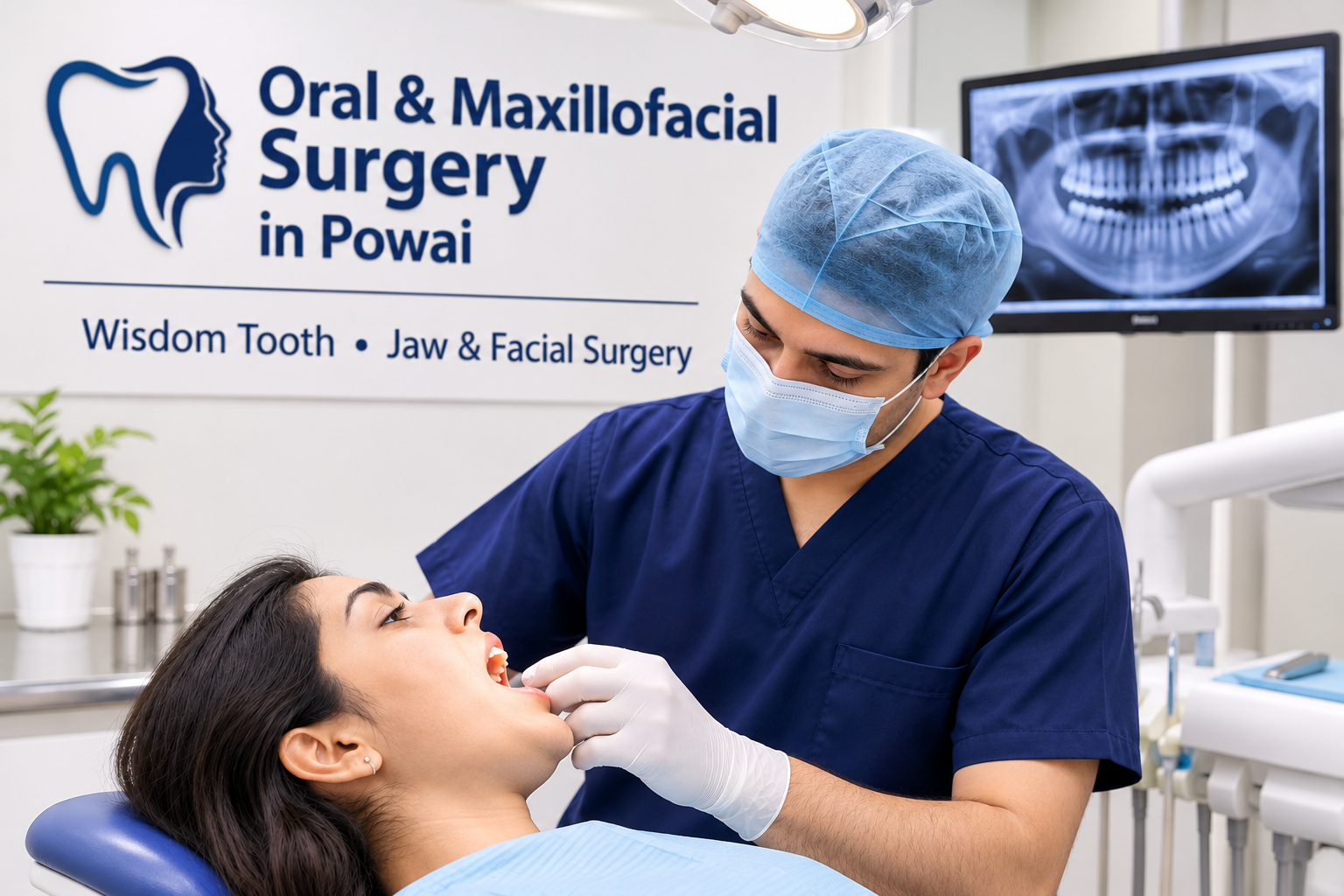
Oral & Maxillofacial Surgery in Powai: Wisdom Tooth, Jaw & Facial Surgery
Most dental problems are handled with fillings, cleanings, and root canals. Some need surgery: a wisdom tooth stuck under the gum, a cyst in the jaw, a tooth broken below the gumline, or an injury to the face. For these, the right surgical care matters, because the jaw contains nerves, sinuses, and blood vessels that need to be respected.
This page explains what oral and maxillofacial surgery in Powai covers, when you may need it, how common procedures work, what recovery looks like, and how to choose a surgeon you can trust.
What Is Oral and Maxillofacial Surgery?
Oral and maxillofacial surgery is the branch of dentistry that treats conditions of the teeth, jaws, mouth, and facial structures using surgical methods. Specialists in this field complete an MDS in Oral and Maxillofacial Surgery after their BDS.
It covers a range, from routine surgical extractions to complex jaw and facial procedures. Many common procedures, such as wisdom tooth removal, are performed in the clinic under local anaesthesia. More complex jaw and facial surgery is planned carefully and may involve hospital facilities.
Conditions and Procedures Covered
Wisdom tooth removal
Impacted, partially erupted, or repeatedly infected wisdom teeth are among the most common reasons for oral surgery.
Surgical and difficult extractions
Teeth broken below the gumline, teeth with curved or fused roots, and teeth that cannot be removed with simple forceps.
Cyst and lesion removal
Cysts and other growths in the jaw are usually found on X-rays and often need surgical removal and testing.
Pre-implant surgery
Bone grafting and other preparation to create enough bone for an implant.
Jaw and facial injuries
Fractures of the jaw or other facial bones after accidents, treated by repositioning and stabilising the bones.
Jaw alignment surgery
For skeletal bite problems that braces alone cannot fix, planned together with an orthodontist.
Jaw joint (TMJ) problems
Most are managed without surgery. Surgery is reserved for selected cases that do not respond to other care.
Infections of the jaw and face
Spreading dental infections may need drainage and urgent care.
Which of these a particular clinic performs in-house varies. Ask the clinic what is done on site and what is referred, so you know what to expect.
When Should You See an Oral Surgeon?
- Pain, swelling, or repeated infection around a wisdom tooth
- A tooth that cannot be saved and needs surgical removal
- A lump, swelling, or cyst in the jaw
- A mouth ulcer that has not healed in 2 weeks
- Missing teeth with bone loss, before implants
- A jaw injury or suspected fracture
- Facial swelling with fever or trouble swallowing (seek urgent care)
Wisdom Tooth Removal in Powai
Why wisdom teeth cause trouble
They are the last teeth to erupt, often without enough space. They can get stuck (impacted), grow at an angle, trap food, cause gum infection, or damage the tooth in front.
Do all wisdom teeth need removal?
No. Wisdom teeth that are healthy, fully erupted, and easy to clean can often stay. Removal is advised when there is pain, infection, decay, cyst formation, damage to neighbouring teeth, or a clear plan for orthodontic treatment. A good dentist explains why your tooth needs to come out.
The procedure
- Examination and X-ray (sometimes a CBCT scan when the tooth is close to a nerve)
- Local anaesthesia so the area is numb
- A small gum opening if the tooth is impacted, with the tooth sectioned if needed
- Removal of the tooth and cleaning of the socket
- Stitches if required, and gauze to control bleeding
Time: Roughly 20 to 60 minutes per tooth depending on complexity.
Recovery After Oral Surgery
First 24 hours
- Bite on gauze as advised to control bleeding
- Use cold packs on the cheek in short intervals
- Do not spit forcefully, rinse hard, or use a straw
- Avoid smoking and tobacco
- Eat soft, lukewarm food
Days 2 to 7
- Swelling is usually highest around day 2 to 3, then settles
- Start gentle warm salt water rinses after 24 hours, as advised
- Take medicines exactly as prescribed
- Keep the rest of your mouth clean
Dry socket
Severe, worsening pain 2 to 4 days after an extraction, sometimes with a bad taste, can mean the blood clot has been lost. It is treatable, so contact your dentist.
Contact the clinic urgently if:
- Bleeding does not stop with pressure
- Swelling increases after day 3
- You have a fever
- You have difficulty swallowing or breathing (go to a hospital)
Most people return to routine activity within a few days after simple wisdom tooth surgery. Healing time varies, and your dentist will give written aftercare instructions.
Anaesthesia Options
- Local anaesthesia: the area is numb and you stay awake. Used for most clinic procedures.
- Local anaesthesia with sedation: for anxious patients or longer procedures, where available.
- General anaesthesia: for complex surgery, given in a hospital or properly equipped setting.
Your surgeon will recommend the safest option for your case and medical history.
Is a CBCT Scan Needed?
Standard X-rays are enough for many extractions. A CBCT scan gives a 3D view and is useful when a wisdom tooth is close to a nerve or sinus, for cysts, for implant planning, and for complex cases. It is advised only when it will change the plan.
Cost of Oral Surgery in Powai
| Procedure | Approximate Cost |
|---|---|
| Consultation and examination | ₹200 – ₹500 |
| Simple extraction | ₹500 – ₹1,500 |
| Surgical extraction | ₹2,000 – ₹5,000 |
| Wisdom tooth removal | ₹3,000 – ₹10,000 per tooth |
| Cyst removal | ₹8,000 – ₹20,000 |
| Bone grafting (for implants) | ₹8,000 – ₹25,000 |
| CBCT scan | ₹2,000 – ₹10,000 |
These are approximate ranges. Complex jaw and facial surgery varies widely and is quoted individually after examination and imaging. You receive a written estimate before treatment.
How to Choose an Oral Surgeon in Powai
- Ask about their qualification and specialty, and the registration with the state dental council
- Ask how many procedures like yours they perform
- Ask whether imaging, including CBCT, is used when needed
- Ask what anaesthesia options are available and where complex surgery is done
- Expect a clear written plan with risks, recovery, and cost
- Ask how to reach the clinic if there is bleeding or severe pain afterwards
- Be wary of pressure to decide quickly
Why Dental Surgeons Planet for Oral Surgery in Powai
- Clear examination, imaging, and explanation before any procedure
- Extractions and wisdom tooth care with detailed aftercare instructions
- Pre-implant planning and related care under one roof
- Written estimate before treatment
- Convenient for Hiranandani, Chandivali, Kanjurmarg, and Vikhroli residents
FAQs
1. Is wisdom tooth removal painful?
The procedure is done under anaesthesia, so you feel pressure but not pain. Soreness and swelling afterwards are normal and manageable with prescribed medicines.
2. How long is recovery after wisdom tooth surgery?
Most people feel better in 3 to 5 days, with swelling peaking around day 2 to 3. Full gum healing takes a few weeks.
3. How much does wisdom tooth removal cost in Powai?
Roughly ₹3,000 to ₹10,000 per tooth depending on how difficult it is. You get a written estimate after examination.
4. Do I need to remove a wisdom tooth that does not hurt?
Not always. Your dentist will advise based on X-rays, position, and risk of infection or damage to other teeth.
5. What is the difference between a normal and a surgical extraction?
A simple extraction removes a visible tooth with forceps. A surgical extraction involves a small gum opening and sometimes sectioning the tooth, as with impacted wisdom teeth.
6. Can both sides be done together?
Sometimes. It depends on the difficulty and your comfort. Your dentist will advise.
7. When is jaw surgery needed?
For skeletal bite problems, certain fractures, cysts, and some jaw conditions. It is planned carefully, often together with an orthodontist.
8. What should I do for facial swelling after a toothache?
Seek care the same day. If you have fever, trouble swallowing, or trouble breathing, go to a hospital emergency department.
9. How do I book an oral surgery consultation?
Call or WhatsApp Dental Surgeons Planet on [insert number] and describe your concern. For severe pain or swelling, ask for a same-day slot.
Conclusion
Oral surgery is easier to face when you know why it is needed, what happens, and how recovery works. A careful examination, the right imaging, and a clear written plan make the biggest difference to comfort and outcome.
If you need wisdom tooth removal, a difficult extraction, or an assessment for jaw problems in Powai, Dental Surgeons Planet offers a clear consultation and an honest explanation of your options.
Book your consultation today and get a clear plan before you decide.