


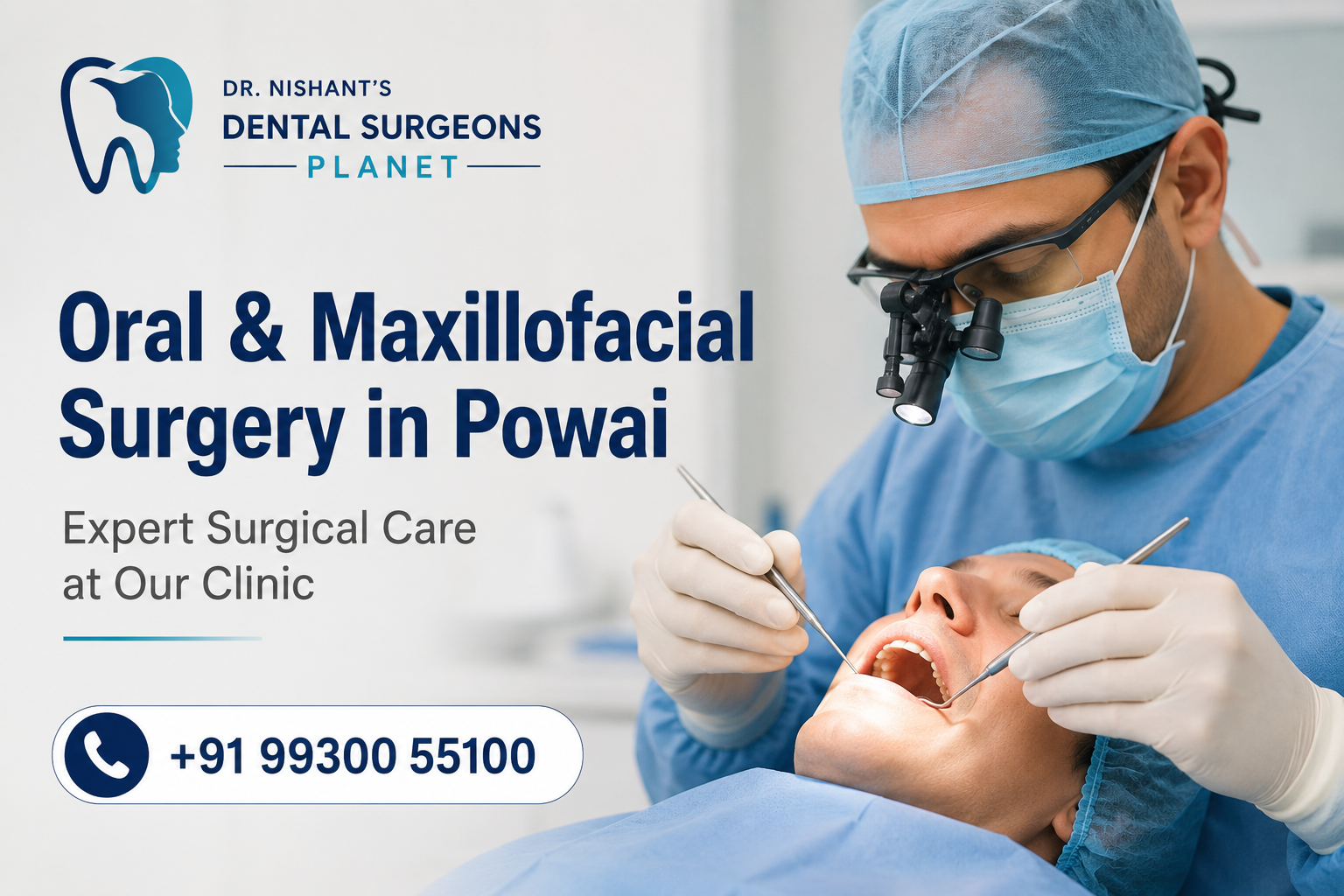
Oral & Maxillofacial Surgery in Powai — Expert Surgical Care at Our Clinic
Most dental treatments — fillings, root canals, cleanings, veneers — are routine procedures that a skilled general dentist handles comfortably every single day. But there is a category of dental and facial conditions that goes beyond routine. Impacted wisdom teeth buried deep in the jawbone. Jaw misalignment affecting how you bite and speak. Facial injuries from accidents. Cysts and tumours growing silently inside the jaw. Infections that have spread beyond the tooth into surrounding bone and tissue.
These conditions require a different level of expertise entirely.
Oral and maxillofacial surgery in Powai addresses exactly this — complex surgical procedures involving the mouth, jaw, face, and surrounding structures that require specialised surgical training, precision, and advanced clinical judgment beyond general dentistry.
If you have been referred for oral surgery or are experiencing any of the conditions covered in this guide, here is everything you need to know before your consultation.
What Is Oral and Maxillofacial Surgery?
Oral and maxillofacial surgery is a recognised dental surgical specialty focused on diagnosing and treating diseases, injuries, and defects involving the hard and soft tissues of the mouth, jaws, face, and neck.
An oral and maxillofacial surgeon completes a BDS degree followed by an MDS in Oral and Maxillofacial Surgery — a postgraduate specialisation that covers surgical anatomy, anaesthesia, facial trauma management, reconstructive surgery, and advanced bone and tissue procedures in depth.
This specialisation places oral and maxillofacial surgeons at the intersection of dentistry and medicine — qualified to handle conditions that range from impacted tooth removal to jaw reconstruction and facial trauma repair.
Conditions Treated by Oral and Maxillofacial Surgery in Powai
Impacted Wisdom Teeth
Wisdom teeth that are partially or fully trapped beneath the gum or growing at an angle are among the most common reasons patients need oral surgery in Mumbai. Left untreated, impacted wisdom teeth cause persistent pain, recurrent infections, damage to adjacent teeth, and cyst formation around the impacted tooth.
Surgical removal under local or general anaesthesia removes the impacted tooth completely and eliminates the source of infection and damage permanently.
Dental Cysts and Tumours
Cysts — fluid-filled sacs — and tumours can develop inside the jawbone, often without any pain until they have grown significantly. They are usually detected on routine X-rays and require surgical removal to prevent progressive bone destruction.
Early detection and prompt surgical treatment prevents the extensive bone loss and reconstructive procedures that delayed diagnosis requires.
Jaw Surgery — Orthognathic Surgery
Severe jaw misalignment — where the upper and lower jaws do not meet correctly due to skeletal discrepancy rather than just tooth position — cannot be corrected by braces alone. Orthognathic surgery repositions one or both jaws surgically to achieve proper alignment, improving both function and facial appearance.
Orthognathic surgery is typically planned in coordination with an orthodontist, combining braces and surgery for a complete, stable result. Patients with severe overbite, underbite, open bite, or facial asymmetry are commonly treated this way.
Facial Trauma and Fractures
Injuries from road accidents, sports, falls, or physical trauma can fracture the jawbone, cheekbones, or other facial bones and damage surrounding soft tissue. Oral and maxillofacial surgeons are trained to manage facial fractures — repositioning and stabilising fractured bone with plates and screws, repairing lacerations, and restoring normal facial appearance and function after trauma.
Pre-Implant Bone Grafting
Patients who have lost significant bone due to tooth loss, gum disease, or infection may not have adequate bone density to support dental implants. Bone grafting — placing bone material into the deficient area to regenerate volume and density — is a standard oral surgical procedure that prepares the jaw for successful implant placement.
Temporomandibular Joint Disorders — TMJ
The temporomandibular joint connects your lower jaw to your skull and is responsible for every chewing, speaking, and jaw movement. TMJ disorders cause jaw pain, clicking, limited mouth opening, and headaches. Severe cases that do not respond to conservative treatment may require surgical intervention to repair or reconstruct the joint.
Oral Infections and Abscesses
Serious dental infections that have spread into the spaces around the jaw, neck, or face require surgical drainage and management beyond what antibiotic treatment alone can achieve. Oral and maxillofacial surgeons manage these infections surgically to protect the airway and prevent life-threatening spread.
Cleft Lip and Palate
Surgical repair of congenital cleft lip and palate deformities falls within the scope of oral and maxillofacial surgery, involving staged reconstructive procedures that restore normal appearance and function.
What to Expect at Your Oral Surgery Consultation in Powai
Your first appointment begins with a thorough clinical examination and digital imaging — typically an OPG (panoramic X-ray) and in complex cases a CBCT scan that provides a three-dimensional view of your jaw anatomy, bone structure, and any pathology present.
Your oral surgeon reviews your medical history, current medications, and any relevant systemic conditions before recommending treatment. A detailed explanation of the proposed procedure, anaesthesia options, expected recovery, and complete cost breakdown is provided before you make any decision.
At a qualified oral surgery clinic in Powai Mumbai, you will never be pressured to proceed immediately. Complex surgical decisions deserve complete understanding — and a good oral surgeon ensures you have it.
Anaesthesia Options for Oral Surgery in Powai Mumbai
Local anaesthesia — used for most outpatient oral surgical procedures. The surgical area is completely numb before and throughout the procedure. You remain fully conscious but feel nothing.
Sedation with local anaesthesia — for anxious patients or longer procedures. Mild sedation keeps you relaxed and comfortable while local anaesthesia manages pain.
General anaesthesia — used for complex procedures, multiple surgical sites, or patients with significant anxiety or special needs. Administered in a fully equipped surgical setting with appropriate monitoring.
Your oral surgeon will recommend the most appropriate option based on procedure complexity, your medical history, and your personal preference.
Recovery After Oral Surgery — What to Expect
Recovery varies depending on the procedure. Wisdom tooth removal typically involves 3 to 5 days of mild swelling and soreness before most patients resume normal activities. More complex jaw surgery or reconstructive procedures require longer recovery with specific dietary and activity restrictions.
General aftercare guidance for most oral surgical procedures includes eating soft foods for the first several days, taking prescribed antibiotics and anti-inflammatory medication as directed, applying ice packs to manage swelling in the first 24 hours, avoiding smoking for at least 72 hours or ideally longer, rinsing gently with warm salt water starting 24 hours after surgery, and attending all follow-up appointments to monitor healing.
Your surgeon will provide procedure-specific aftercare instructions that cover your individual recovery requirements in detail.
Oral and Maxillofacial Surgery Cost in Powai Mumbai
| Procedure | Approximate Cost |
|---|---|
| Surgical Wisdom Tooth Removal | ₹3,000 – ₹10,000 per tooth |
| Dental Cyst Removal | ₹8,000 – ₹20,000 |
| Bone Grafting for Implants | ₹8,000 – ₹25,000 |
| Orthognathic Jaw Surgery | ₹1,50,000 – ₹5,00,000 |
| Facial Fracture Repair | ₹30,000 – ₹1,50,000 |
| TMJ Surgical Treatment | ₹20,000 – ₹80,000 |
Costs vary based on complexity, anaesthesia type, and whether hospitalisation is required. A complete written estimate is always provided after clinical evaluation and imaging.
Why Choose an Oral Surgeon in Powai Mumbai
Powai is home to some of Mumbai's most qualified dental specialists — including oral and maxillofacial surgeons with MDS qualifications, advanced surgical training, and extensive experience managing the full spectrum of oral surgical conditions.
Choosing a qualified oral surgery clinic in Powai Mumbai means access to advanced digital imaging including CBCT scanning for precise surgical planning, experienced MDS-qualified oral surgeons with subspecialty training, full anaesthesia capability for outpatient and complex procedures, sterile surgical environments meeting infection control standards, and coordinated care with other dental specialists — orthodontists, implantologists, and prosthodontists — when combined treatment planning is required.
FAQs
Q1. Is oral surgery painful?
No. All oral surgical procedures are performed under appropriate anaesthesia — local, sedation, or general depending on the case. You will feel no pain during the procedure. Post-operative soreness is managed with prescribed medication and typically resolves within a few days for most procedures.
Q2. How long does wisdom tooth surgery take in Powai Mumbai?
A straightforward surgical wisdom tooth removal takes 20 to 45 minutes per tooth under local anaesthesia. Multiple impacted wisdom teeth may be removed in the same appointment or across two visits depending on complexity.
Q3. How do I know if I need oral surgery or can a general dentist treat me?
If your dentist has referred you to an oral surgeon, the condition is beyond routine care. Impacted teeth, cysts, jaw misalignment, facial trauma, and bone grafting all require the specialised training of a qualified oral and maxillofacial surgeon.
Q4. Is bone grafting necessary before dental implants?
Only when there is insufficient bone density to support an implant securely. Your surgeon will assess bone volume using a CBCT scan and recommend grafting only when genuinely necessary for long-term implant stability.
Q5. What is the recovery time after jaw surgery in Mumbai?
Orthognathic jaw surgery typically involves a hospital stay of 1 to 2 days followed by 4 to 6 weeks of dietary restriction and activity limitation. Swelling reduces progressively over 6 to 12 weeks. Full bone healing takes 3 to 6 months.
Q6. Can oral surgery be done under general anaesthesia in Powai?
Yes. Advanced oral surgery clinics in Powai Mumbai have the facility and qualified personnel for procedures requiring general anaesthesia, with full patient monitoring throughout.
Conclusion
Oral and maxillofacial surgery covers some of the most complex, consequential procedures in dental medicine — and the outcome depends almost entirely on the experience and qualification of the surgeon performing it.
Whether you need surgical wisdom tooth removal, jaw realignment, cyst removal, facial trauma repair, or bone grafting for implants — choosing a qualified oral and maxillofacial surgeon in Powai Mumbai with an MDS specialisation and proven surgical experience is the decision that determines your result.
Do not delay a referral or put off a consultation for conditions that require surgical attention. Early intervention almost always means simpler procedures, faster recovery, and significantly better outcomes.
Visit our oral surgery clinic in Powai Mumbai today for a comprehensive evaluation, precise digital imaging, and a clear, honest surgical plan from a specialist who puts your safety and recovery first.
Book your oral surgery consultation in Powai today — expert surgical care, right when you need it.