


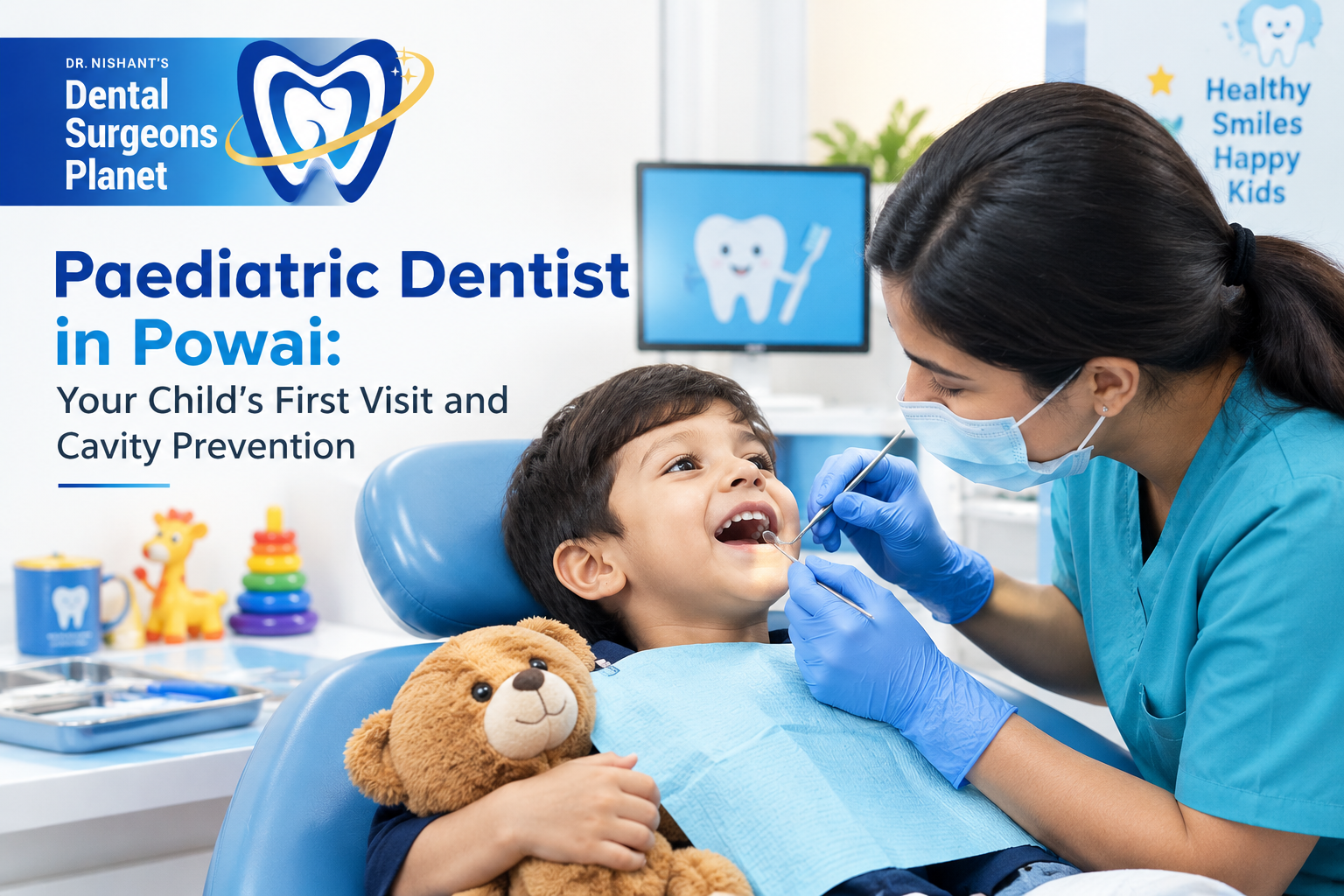
Paediatric Dentist in Powai: Your Child’s First Visit and Cavity Prevention
Your child’s relationship with dental care begins before they ever understand what a dentist is. The environment they experience at their first visit, the way the dentist speaks to them, whether they leave feeling safe or frightened — these early impressions shape how they approach oral health for the rest of their life.
Most adults who feel genuine anxiety at a dental appointment today can trace that fear to a specific childhood experience. A procedure that hurt. A dentist who rushed. An environment that felt clinical and frightening rather than safe and welcoming.
Paediatric dentistry in Powai at Dental Surgeons Planet is built around preventing that outcome entirely. Every element of how we approach children — the language we use, the pace we set, the way we introduce each instrument before it touches a child’s mouth — is designed to create a genuinely positive experience that children leave without fear and sometimes even look forward to repeating.
This guide answers the questions every parent in Powai and Mumbai asks before their child’s first dental visit — when to start, what to expect, how to prepare your child, what cavity prevention actually involves, and how to build the habits that protect your child’s teeth through childhood and into adulthood.
When Should Your Child First See a Dentist?
This is the question most parents ask first — and the answer consistently surprises them.
The recommendation from paediatric dentists is the first dental visit within 6 months of the first tooth appearing, or by your child’s first birthday — whichever comes first.
Most parents in Mumbai bring their children to the dentist for the first time between ages 3 and 5 — often only when a visible problem like a cavity or toothache prompts the visit. By this point, opportunities for early prevention have already been missed, and in some cases early childhood cavities are already present and require treatment.
The first-year dental visit is not about drilling or treatment. It is about three specific things that have lasting value:
Familiarisation — Your child is introduced to the dental environment, the dentist, and the clinic before any discomfort or anxiety is associated with it. This builds a positive foundation for every future visit.
Early assessment — Your dentist checks that teeth are erupting normally, that jaw development is on track, and that no early developmental concerns are present. Problems caught at this stage are far simpler to address than the same problems discovered at age 7 or 8.
Parent education — The first visit is as much about you as your child. Your dentist provides specific, personalised guidance on feeding habits, thumb sucking, pacifier use, teething management, fluoride, and the home care routine appropriate for your child’s current stage of development.
Starting early does not mean subjecting your infant to dental treatment. It means building a relationship with dental care that is positive, familiar, and completely unthreatening from the very beginning.
What Happens at Your Child’s First Visit to Our Paediatric Clinic in Powai
Parents who know what to expect are significantly better able to prepare their children — and significantly less anxious themselves, which children reliably detect and mirror.
Arrival and welcome
Our clinic environment in Powai is designed to feel genuinely welcoming rather than clinical. The reception area is child-friendly. The team greets children directly — not just their parents — using their name and a warm, unhurried tone that establishes the visit as non-threatening from the first moment.
The tell-show-do approach
This is the foundational communication method in paediatric dentistry and it is used consistently throughout every appointment at Dental Surgeons Planet Powai.
Before any instrument is used near a child’s mouth, the dentist explains what it is in simple, accessible language — not “explorer” but “tooth counter,” not “suction” but “water vacuum.” The child sees and sometimes touches the instrument before it is used. Then it is used — having already been demystified.
This approach works because dental fear is primarily fear of the unknown. Children who know what is happening — who have been shown and explained rather than surprised — respond with far less anxiety than children who experience procedures without preparation.
First examination
For very young children, the knee-to-knee examination is standard — the child sits on the parent’s lap facing the parent, then reclines so their head is in the dentist’s lap. This keeps the child physically close to the parent throughout the examination while giving the dentist full access. For older children, a standard dental chair with the parent seated visibly nearby is appropriate.
The dentist counts and examines each tooth, checks the gum tissue, assesses bite development, and evaluates tongue tie, lip tie, and palatal development. Digital X-rays are taken when clinically indicated — typically when teeth are touching and cavities between them cannot be assessed visually.
Parent consultation
After the clinical examination, your dentist discusses findings, answers every question you have, and provides specific recommendations for home care, diet modification if indicated, and the optimal interval for the next visit.
Total appointment time — first visit
30 to 45 minutes. This includes the examination, any indicated X-rays, the parent consultation, and — importantly — unhurried time with your child to ensure the experience ends positively.
Cavity Prevention in Children — What Actually Works
Cavity prevention in children is not complicated. But it requires consistency, the right information, and starting at the right age. Here is what the evidence and clinical experience at our Powai clinic says about each element.
Fluoride — the most effective cavity prevention tool available
Fluoride strengthens enamel by incorporating into its crystal structure — creating a mineral called fluorapatite that is significantly more resistant to acid attack than the natural enamel it replaces. It also inhibits the metabolism of Streptococcus mutans — the primary cavity-causing bacterium — reducing acid production directly.
For children in Powai Mumbai, fluoride is relevant in several forms:
Fluoride toothpaste — the most important daily fluoride source. A smear of fluoride toothpaste (approximately the size of a grain of rice) from the appearance of the first tooth. A pea-sized amount from age 3. Parents should brush for children until they can reliably spit — typically around age 6 to 7 — because swallowing significant fluoride toothpaste during tooth development can cause fluorosis.
Professional fluoride varnish — a high-concentration fluoride gel applied by the dentist to all tooth surfaces during check-up appointments. Takes approximately 2 minutes to apply, sets quickly, and provides concentrated fluoride delivery to enamel that dietary fluoride and toothpaste alone cannot match. Recommended every 6 months from the first tooth eruption.
Fissure sealants — physically blocking cavities from forming
The chewing surfaces of permanent back teeth — particularly the first permanent molars that erupt around age 6 and the second permanent molars that erupt around age 12 — have deep fissures and pits in their surface anatomy that are essentially impossible to clean effectively with a toothbrush. Food and bacteria become trapped in these narrow channels and cavities develop from the inside out — often undetectable until significant decay has occurred.
Fissure sealants are a thin resin coating flowed into these fissures and light-cured to create a smooth, sealed surface that eliminates the trapping site entirely. The procedure takes 10 to 15 minutes per tooth, requires no drilling, no anaesthesia, and no discomfort — it is simply cleaning, conditioning, and sealing the tooth surface.
Research consistently shows that sealed molars have dramatically lower cavity rates than unsealed ones. At Dental Surgeons Planet Powai, sealant placement on newly erupted permanent molars is one of our most strongly recommended preventive treatments for children aged 6 to 13.
Dietary counselling — understanding the cavity equation
Cavities are caused by acid — specifically, acid produced by oral bacteria metabolising fermentable carbohydrates. The equation is simple: bacteria plus sugar plus time equals acid plus enamel dissolution equals cavity.
The dietary factors that matter most for cavity prevention in Mumbai children:
Frequency of sugar exposure matters more than total quantity. A child who drinks a sugared drink over 4 hours has significantly higher cavity risk than a child who drinks the same amount in 15 minutes — because each exposure event resets the acid attack cycle. Grazing on biscuits and snacks throughout the day is significantly more cavity-promoting than eating the same foods at defined meal times.
Night-time feeding practices in infants and toddlers. Falling asleep with a bottle of milk, formula, or juice — or prolonged breastfeeding through the night beyond 12 months — pools fermentable liquid against the teeth during the hours when saliva flow is lowest and the natural acid buffering of the mouth is most reduced. This is the primary cause of early childhood caries — a pattern of severe cavities affecting upper front teeth in very young children that is entirely preventable with feeding practice modification.
Mumbai-specific dietary factors — the high frequency of sweet chai, mithai consumption, frequent small snack meals, and the cultural practice of giving children sweet foods as treats or comfort all contribute to elevated cavity risk in the Mumbai paediatric population compared to populations with different dietary cultures. Awareness of these specific factors is part of the dietary counselling provided at Dental Surgeons Planet Powai.
Home oral hygiene — what the routine should look like at each age
Age 0 to 12 months: Wipe gum pads with a clean damp cloth after feeds. When teeth begin appearing, wipe tooth surfaces with a damp cloth or soft infant toothbrush — no toothpaste yet.
Age 12 months to 3 years: Brush twice daily using a small soft-bristle infant toothbrush and a smear of fluoride toothpaste. Parents brush — children cannot clean their own teeth effectively at this age regardless of their enthusiasm for the toothbrush.
Age 3 to 6 years: Pea-sized fluoride toothpaste, twice daily, parents brushing with supervision. Begin introducing flossing once any teeth are touching — typically from age 3 to 4.
Age 6 to 9 years: Children begin brushing themselves with continued parental supervision and checking. Parents should check brushing quality regularly — children at this age consistently miss the same areas, typically the inner surfaces of lower front teeth and the back molars. Electric toothbrushes at this age improve coverage significantly.
Age 9 and above: Independent brushing with parents spot-checking until the early teens. Flossing independently once teeth are touching.
Regular dental checkups — the safety net that catches what prevention misses
Even the most diligent home care and dietary management does not prevent every cavity. Regular 6-monthly checkups at our paediatric dental clinic in Powai provide the safety net — identifying early cavities when they are small, monitoring erupting teeth, assessing jaw development, applying fluoride varnish, and placing sealants at the right developmental windows.
The small cavities found at routine 6-monthly checkups are treated with a simple filling in 15 to 20 minutes. The same cavities found 12 to 18 months later — because checkups were skipped — are treated with pulp therapy and stainless steel crowns. The difference in treatment complexity, cost, and the child’s experience is significant. Prevention through regular attendance is the most practical gift parents give their children’s dental health.
Common Paediatric Dental Treatments at Dental Surgeons Planet Powai
Tooth fillings for children
When a cavity is detected in a baby tooth or permanent tooth, filling it promptly prevents the decay from reaching the pulp — avoiding the need for more extensive treatment. Children’s fillings are done using tooth-coloured composite resin under local anaesthesia where needed. The tell-show-do approach and our team’s experience with child behaviour management makes filling procedures genuinely manageable for most children from age 4 upward.
Pulp therapy — saving infected baby teeth
When decay in a baby tooth reaches the pulp, pulp therapy — the paediatric equivalent of root canal treatment — removes the infected pulp tissue while preserving the tooth until its natural exfoliation time. Baby teeth are not simply expendable. They hold space for permanent teeth, maintain jaw development, support speech, and allow normal eating. Losing them prematurely through untreated decay creates space problems for permanent teeth that require orthodontic treatment to correct.
Pulp therapy for baby teeth is typically completed in one appointment and followed by a stainless steel crown — a pre-formed metal cap that covers and protects the treated tooth reliably until it falls out naturally.
Stainless steel crowns
Pre-formed stainless steel crowns are placed on baby teeth after pulp therapy or when decay has destroyed enough tooth structure that a filling would not be reliable. They are durable, inexpensive, and require no laboratory fabrication — completed chairside in a single appointment. The silver appearance is visible when the child smiles broadly but is located on back teeth in most cases and causes no functional concern.
Space maintainers
When a baby tooth is lost prematurely — through extraction following untreated decay, or from trauma — the adjacent teeth begin moving into the gap within weeks. A space maintainer is a fixed or removable appliance that holds the space open until the permanent tooth is ready to erupt. Without it, the permanent tooth erupts into an insufficient or displaced space, creating crowding that requires orthodontic treatment.
Space maintainers are simple, affordable, and prevent significant orthodontic expense. At Dental Surgeons Planet Powai, we discuss space maintenance at every premature extraction appointment rather than leaving the decision to chance.
Orthodontic assessment and early intervention
Age 7 is the recommended age for a first orthodontic assessment — not because treatment necessarily begins at this age, but because certain developing problems are best intercepted at this age when jaw bones are still growing and more responsive to guidance appliances.
Crossbites — where upper teeth sit inside lower teeth — are best corrected during growth rather than after. Significant crowding that will require extraction for resolution is identified early enough that interception may create adequate space without extraction. Skeletal jaw discrepancies that will require surgical correction if left until adulthood may be amenable to growth modification appliances when treated in the mixed dentition period.
Early assessment does not mean early treatment for every child. It means informed, timely decision-making rather than discovering at 14 that a problem was best addressed at 9.
How to Prepare Your Child for Their First Dental Visit — Practical Parent Guide
What parents do in the days before a first dental visit significantly influences how the child arrives — curious and open or already anxious and defensive.
Use positive, neutral language
Avoid words that carry negative dental connotations — pain, injection, drill, hurt, scared. These words create anticipatory anxiety before anything has happened. Instead: “We are going to meet Dr. Gandhi who counts and cleans teeth. We will see the special chair that goes up and down.”
Read books about dental visits
Several excellent children’s books about visiting the dentist are available — Peppa Pig’s Dentist Trip, The Berenstain Bears Visit the Dentist, and similar titles normalise dental visits as routine and positive rather than frightening.
Avoid using the dentist as a threat
“If you don’t brush your teeth, the dentist will have to drill them” — variations of this are surprisingly common and create precisely the fear that makes paediatric dental care harder. The dentist should be framed as someone who helps keep teeth healthy, not someone who punishes poor oral hygiene.
Do not share your own dental anxiety
Children are highly attuned to parental emotional states. A parent who is visibly anxious about a dental visit communicates that anxiety to their child without saying a word. If you have dental anxiety yourself, keeping the pre-visit conversation matter-of-fact and positive — even if you feel otherwise — is one of the most important things you can do for your child’s dental experience.
Visit the clinic for a familiarisation appointment
For very anxious children or children with sensory sensitivities, a brief familiarisation visit — just sitting in the chair, meeting the dentist, seeing the instruments — with no treatment at all can be enormously effective. At Dental Surgeons Planet Powai, we accommodate familiarisation visits as needed for children who need more time to become comfortable before their first examination.
Practice at home
Let your child count your teeth with their finger. Count their teeth yourself and name them. Make tooth brushing interactive rather than mechanical — sing a two-minute song, use a timer app, let them choose their toothbrush. Children who are comfortable with the concept of teeth being examined and cleaned at home respond far better to the same activities in a clinical setting.
Paediatric Dental Care Costs at Dental Surgeons Planet Powai
| Treatment | Approximate Cost |
|---|---|
| First visit consultation and examination | ₹300 – ₹600 |
| Digital X-rays (bitewing or periapical) | ₹300 – ₹800 |
| Professional fluoride varnish application | ₹500 – ₹1,000 |
| Fissure sealant per tooth | ₹500 – ₹1,200 |
| Tooth filling — composite | ₹800 – ₹2,500 |
| Pulp therapy (baby tooth) | ₹2,000 – ₹4,000 |
| Stainless steel crown | ₹2,000 – ₹4,000 |
| Space maintainer | ₹3,000 – ₹6,000 |
| Orthodontic assessment | ₹300 – ₹600 |
| Routine 6-monthly checkup | ₹300 – ₹600 |
Preventive treatments — fluoride varnish and fissure sealants — represent the lowest-cost interventions with the highest long-term value in the entire paediatric dental treatment spectrum. A full set of molar sealants for a 6-year-old costs ₹2,000 to ₹5,000 and prevents cavities in those teeth for years. A single molar that develops a cavity and requires pulp therapy and a stainless steel crown costs ₹4,000 to ₹8,000 — for one tooth, one time, without the prevention that could have made it unnecessary.
Why Parents in Powai Mumbai Choose Dental Surgeons Planet for Their Children
Families across Powai, Hiranandani, Chandivali, Vikhroli, and Kanjurmarg bring their children to Dental Surgeons Planet specifically because of the consistent experience they find — a team that genuinely understands child behaviour and communication, an environment that does not feel threatening to young patients, and a clinical approach that prioritises long-term oral health through prevention rather than reactive treatment.
Parents who bring their own children here consistently describe the same outcome — a child who was anxious about the first visit and comfortable by the second or third. That trajectory, from anxious to comfortable, is the outcome that paediatric dentistry should reliably produce, and it is what the team at Dental Surgeons Planet Powai is specifically trained and oriented to achieve.
FAQs
Q1. My child is 4 years old and has never seen a dentist — is it too late to start?
Not at all. While the ideal first visit is within 6 months of the first tooth, starting at age 4 is far better than waiting longer. A first visit at 4 gives your dentist the opportunity to assess current tooth health, apply preventive fluoride varnish, place sealants on any erupting permanent teeth, and establish the positive dental visit habit before school age — when peer influences and independence make new habits harder to establish.
Q2. My child refuses to open their mouth at the dentist — what can be done?
This is one of the most common challenges in paediatric dentistry and one the team at Dental Surgeons Planet Powai handles regularly. Tell-show-do, familiarisation visits, parental proximity, and patient pacing resolve this for the vast majority of children across 2 to 3 visits. For children with significant anxiety or special needs, specific behaviour management techniques including nitrous oxide sedation can be discussed where clinically appropriate.
Q3. Are baby teeth really worth treating — they fall out anyway?
Yes — emphatically. Baby teeth are not temporary placeholders of no clinical significance. They hold space for permanent teeth, guide jaw development, support speech development, and allow normal chewing and nutrition for 6 to 10 years of active use. Untreated cavities in baby teeth cause pain, infection, premature tooth loss, and space problems for permanent teeth that require orthodontic treatment to correct. A baby tooth lost 3 years early is 3 years of space management failure.
Q4. When should my child start using toothpaste?
A smear of fluoride toothpaste — approximately the size of a grain of rice — from the appearance of the first tooth. Increase to a pea-sized amount from age 3. Use fluoride toothpaste at all ages — the fluoride is what makes toothpaste valuable for cavity prevention, and non-fluoride children’s toothpastes offer significantly less protection. Ensure children spit rather than swallow from as early as possible.
Q5. How do I know if my child has a cavity if they are not complaining of pain?
Many cavities in children are entirely asymptomatic until they are advanced. Pain from a cavity typically indicates the decay has reached the pulp — the nerve — which means more extensive treatment is needed. Regular 6-monthly checkups at our paediatric dental clinic in Powai detect cavities at the small stage — when they cause no discomfort and require only a simple filling — rather than at the painful stage that parents notice at home.
Q6. At what age should my child start orthodontic treatment?
An orthodontic assessment at age 7 is recommended to identify any developing problems. Active orthodontic treatment — braces or Invisalign — typically begins between 11 and 14 when all permanent teeth are present. Some children benefit from early interceptive treatment with growth appliances between ages 7 and 10 for specific problems like crossbites or severe crowding. Your dentist will advise whether your child is a candidate for early intervention or whether monitoring until the ideal orthodontic window is appropriate.
Conclusion
Your child’s dental health begins earlier than most parents in Powai and Mumbai realise — and the habits, experiences, and preventive treatments established in the first years of life have consequences that extend into adulthood.
A first dental visit in the first year of life. Fluoride varnish at every 6-monthly checkup. Fissure sealants on permanent molars as they erupt. Small cavities treated promptly when they are still small. And a dental experience so consistently positive that your child grows up genuinely comfortable with dental care rather than avoidant of it.
This is paediatric dentistry in Powai at Dental Surgeons Planet — not reactive treatment when things go wrong, but proactive prevention that means fewer things go wrong in the first place.
Book your child’s first dental visit at Dental Surgeons Planet Powai today — gentle, child-friendly, and designed from the first moment to build the positive dental foundation that lasts a lifetime.
Every healthy adult smile starts with the right care in childhood. Yours starts here.