


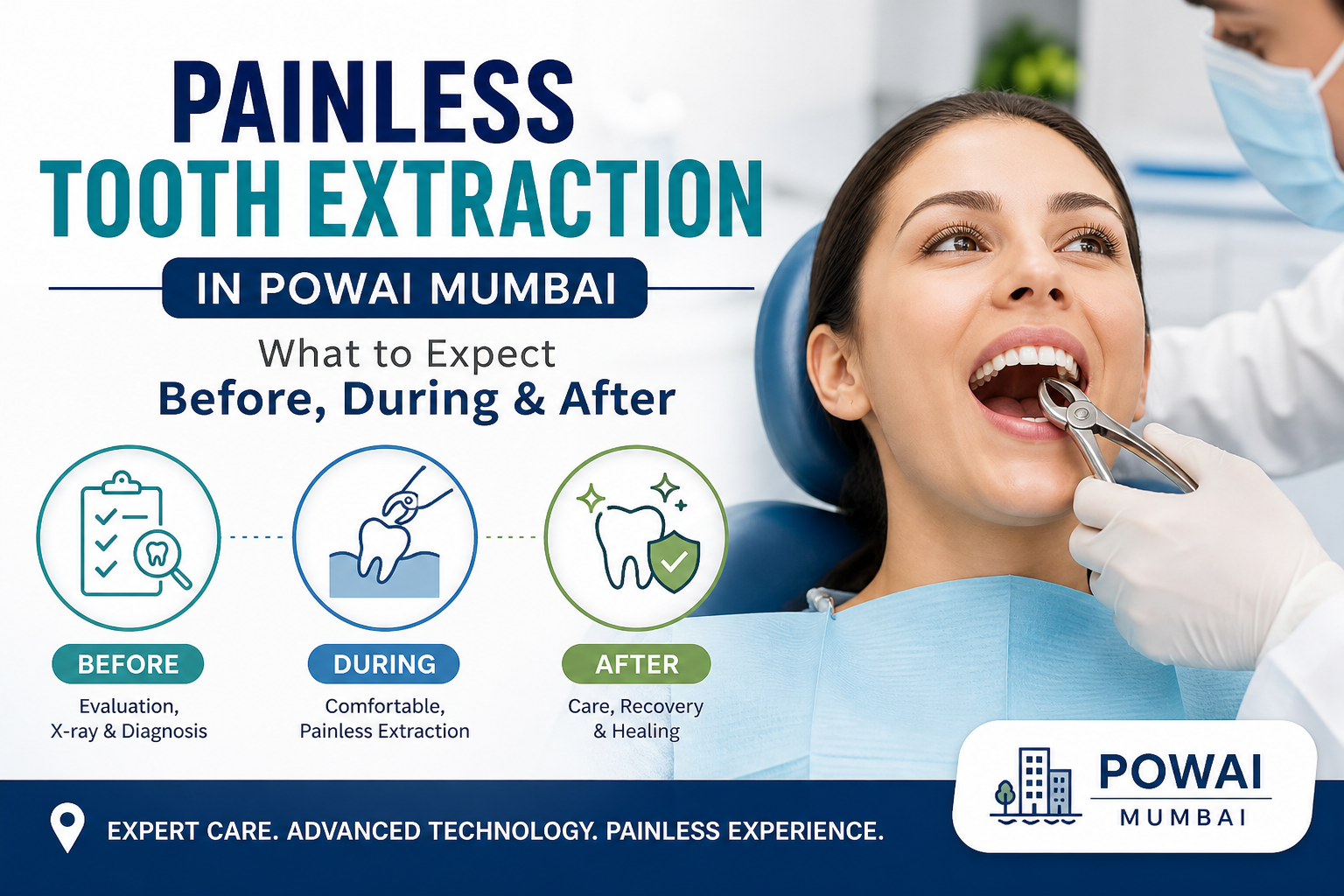
Painless Tooth Extraction in Powai Mumbai: What to Expect Before, During & After
The words "tooth extraction" make most people immediately anxious. Visions of pain, bleeding, and a long uncomfortable recovery flash through the mind — and suddenly even a throbbing toothache feels more manageable than visiting the dentist.
But here is something every dentist in Powai Mumbai wants you to know — modern tooth extraction is nothing like what you imagine.
With today's advanced anaesthesia techniques and gentle extraction methods, most patients sit back in the chair terrified and stand up thirty minutes later saying — "That was it? I felt almost nothing."
This guide walks you through everything — what to do before your appointment, what actually happens during the procedure, and how to recover quickly and comfortably after tooth extraction in Powai Mumbai.
Why Tooth Extraction May Be Necessary
Sometimes saving a tooth is simply not possible. Dentists in Mumbai recommend extraction when:
- Tooth decay has destroyed too much of the tooth structure
- A dental abscess has severely damaged the surrounding bone
- A wisdom tooth is impacted and causing pain or infection
- Overcrowded teeth need removal before braces treatment
- A cracked tooth extends below the gumline and cannot be restored
- Advanced gum disease has made a tooth loose beyond saving
Delaying extraction when it is genuinely needed only makes the situation more painful, more expensive, and more complicated over time.
Before Your Tooth Extraction — What You Should Do
Preparation makes a big difference in how smoothly your procedure goes.
Tell Your Dentist Everything Inform your dentist about all medications you are currently taking — especially blood thinners, diabetes medication, or heart medication. Also mention any allergies, recent illnesses, or medical conditions like diabetes or blood pressure.
Do Not Eat Before Sedation Cases If your extraction involves sedation or general anaesthesia, your dentist will advise you to avoid eating or drinking for several hours before the appointment. For local anaesthesia only, you can eat normally beforehand.
Arrange Transport If sedation is involved, arrange for someone to drive you home after the procedure. Do not plan to drive yourself.
Get a Good Night's Sleep Being well-rested reduces anxiety and helps your body handle the procedure and heal faster afterward.
Avoid Smoking Stop smoking at least 12 hours before extraction. Smoking increases the risk of complications and slows healing significantly.
During the Procedure — What Actually Happens
This is the part most patients dread. Here is exactly what happens — step by step:
Step 1 — Examination and X-Ray Your dentist examines the tooth and takes a quick digital X-ray to understand the root shape and position before beginning.
Step 2 — Local Anaesthesia A numbing gel is applied to the gum first, followed by a small injection of local anaesthetic. Within 3 to 5 minutes the entire area is completely numb. You will feel pressure during the extraction but absolutely no pain.
Step 3 — Loosening the Tooth For a simple extraction, your dentist uses a small instrument called an elevator to gently loosen the tooth from the socket before removing it with forceps. The rocking motion you feel is normal — it is simply widening the socket for easier removal.
Step 4 — Surgical Extraction (If Needed) For impacted wisdom teeth or broken teeth below the gumline, a small incision is made in the gum. The tooth may be sectioned into smaller pieces for easier, less traumatic removal. Stitches are placed to close the gum afterward.
Step 5 — Gauze Placement Once the tooth is removed, gauze is placed firmly on the socket and you are asked to bite down gently to control bleeding and help a clot form.
Total time: Simple extraction — 15 to 30 minutes. Surgical extraction — 30 to 60 minutes.
After Tooth Extraction — Recovery Do's and Don'ts
The first 24 to 48 hours after extraction are the most important for proper healing.
Do This:
- Bite firmly on the gauze for 30 to 45 minutes after reaching home
- Apply an ice pack on your cheek for 10 minutes on and 10 minutes off for the first few hours
- Take all prescribed antibiotics and painkillers as directed without skipping doses
- Eat soft foods — curd, khichdi, mashed dal, banana, and soups
- Sleep with your head slightly elevated on an extra pillow
- Rinse gently with warm salt water starting 24 hours after extraction
Avoid This:
- Do not spit forcefully or rinse vigorously for the first 24 hours — it dislodges the blood clot
- Do not use a straw for at least 48 hours
- Avoid hot, spicy, or crunchy food for 3 days
- Do not smoke or use tobacco for at least 72 hours
- Do not poke the extraction site with your tongue or finger
- Avoid strenuous exercise for 24 hours
Tooth Extraction Cost in Powai Mumbai
| Type of Extraction | Approximate Cost |
|---|---|
| Simple Extraction | ₹500 – ₹1,500 |
| Surgical Extraction | ₹2,000 – ₹5,000 |
| Wisdom Tooth Removal | ₹3,000 – ₹8,000 |
| Emergency Extraction | ₹2,000 – ₹6,000 |
FAQs
Q1. Is tooth extraction painful with anaesthesia? No. Local anaesthesia completely numbs the area. You feel pressure and movement but no pain during the procedure. Any mild soreness after the anaesthesia wears off is easily managed with prescribed painkillers.
Q2. How many days does it take to recover from tooth extraction? Most patients feel completely normal within 3 to 5 days. Full healing of the gum tissue takes 2 to 3 weeks. Wisdom tooth surgical extraction may take slightly longer.
Q3. What is dry socket and how do I avoid it? Dry socket occurs when the blood clot in the extraction socket is lost before healing is complete, exposing the bone underneath and causing significant pain. Avoid spitting, using a straw, and smoking for at least 72 hours to prevent it.
Q4. Can I go to work the next day after tooth extraction? Yes for most simple extractions. For surgical wisdom tooth removal, taking one to two days rest is advisable depending on how you feel.
Q5. What should I eat after tooth extraction? Stick to soft, lukewarm foods like curd, khichdi, mashed vegetables, bananas, and soups for the first 2 to 3 days. Avoid anything hot, hard, crunchy, or spicy until the site heals.
Q6. Do I need a dental implant after extraction? Not immediately — but replacing a missing tooth is strongly recommended to prevent bone loss and shifting of adjacent teeth. Your dentist will discuss implant or bridge options once the extraction site has healed.
Conclusion
Tooth extraction fear is real — but in most cases, it is completely unnecessary with modern dental care. Painless tooth extraction in Powai Mumbai today is a quick, safe, and comfortable procedure that removes pain from your life rather than adding to it.
The key is not to delay. A tooth that needs extraction will not heal on its own. Waiting only allows the infection to spread, the bone to weaken, and the procedure to become more complex.
Visit a trusted dental clinic in Powai Mumbai, get a proper examination, and let an experienced dentist take care of you. Most patients wish they had come in sooner — and you will too.
Book your tooth extraction consultation in Powai Mumbai today and say goodbye to that pain for good.