


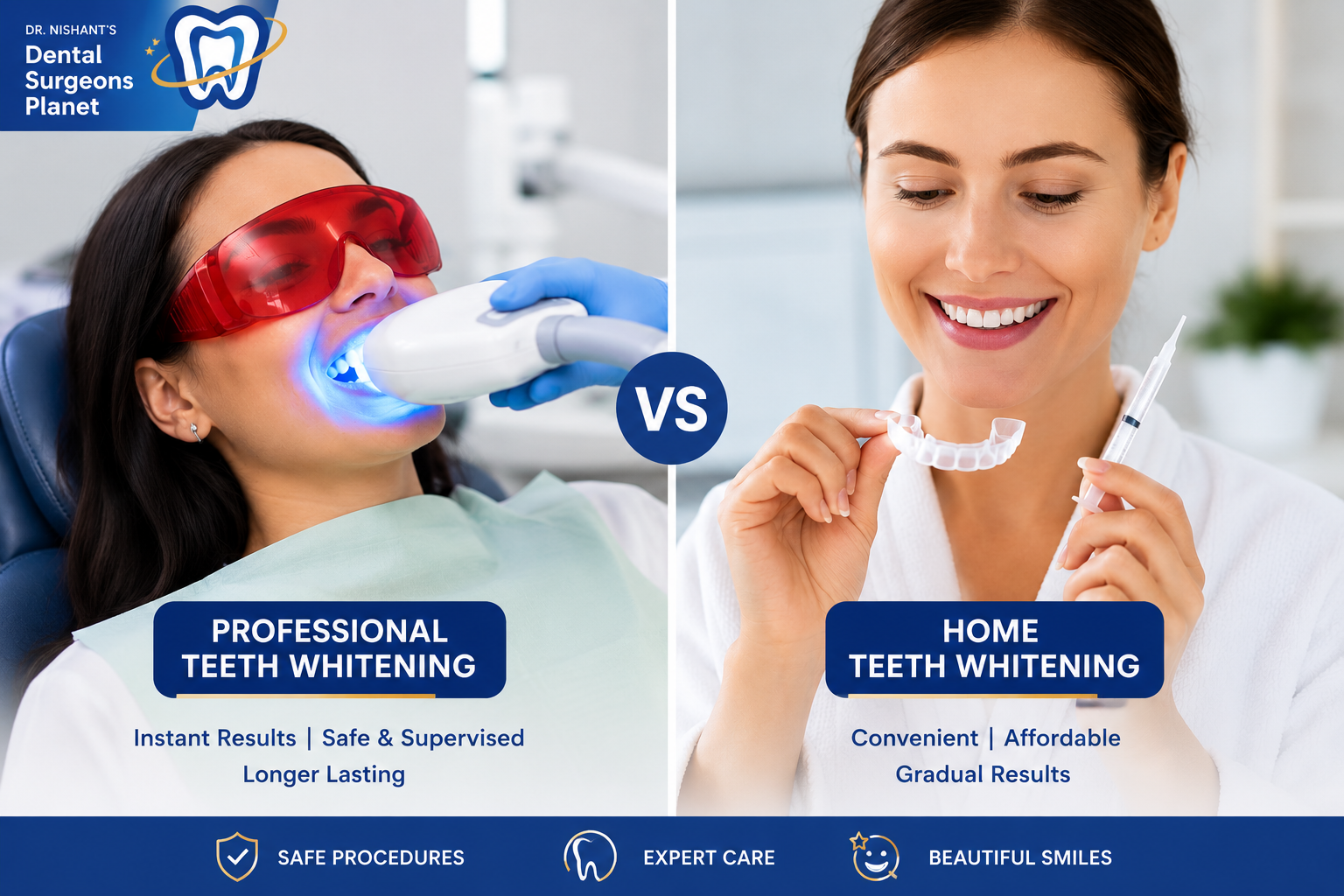
Professional Teeth Whitening vs Home Whitening: Results, Safety & Cost Factors
Walk into any pharmacy in Mumbai and you will find an entire shelf dedicated to teeth whitening — strips, gels, charcoal toothpastes, LED kits, whitening pens, and herbal powders all promising dramatically whiter teeth within days.
Then there is professional teeth whitening at a dental clinic — significantly more expensive, requires an appointment, involves a dentist — but consistently described by patients as delivering results that genuinely surprised them.
So which one is actually worth choosing?
The honest answer depends on what you are trying to achieve, how quickly you want results, how sensitive your teeth are, and what budget you are working with. This guide gives you a genuinely unbiased, clinically accurate comparison of both options — what each delivers, where each falls short, what each costs in Mumbai, and how to decide which one is right for your specific situation.
No product recommendations. No marketing. Just an honest comparison from a clinical perspective.
Understanding Why Teeth Turn Yellow — The Starting Point for Both Options
Before comparing whitening methods, it helps to understand why teeth discolour in the first place — because the type of stain you have determines which whitening approach can actually address it.
Extrinsic staining sits on the outer surface of the enamel. Caused by tea, coffee, red wine, tobacco, and certain foods — this type of staining responds to whitening treatment because the bleaching agent can reach and break down the stain molecules on the enamel surface.
Intrinsic staining is inside the tooth structure itself — in the dentin layer beneath the enamel. Caused by ageing, certain antibiotics like tetracycline taken during childhood, fluorosis, or trauma to the tooth, intrinsic staining is significantly harder to whiten. Professional treatment can improve it but may not eliminate it entirely. Severe intrinsic staining often requires veneers rather than whitening for a complete result.
Knowing which type of staining you have before spending money on any whitening product or procedure is the most important starting point — and something a quick consultation at a dental clinic in Powai Mumbai can tell you immediately.
Professional Teeth Whitening — How It Works
Professional teeth whitening uses a high-concentration hydrogen peroxide or carbamide peroxide gel applied by a qualified dentist. The concentration used in professional treatment — typically 25 to 40 percent hydrogen peroxide — is significantly higher than anything available over the counter in India.
In-clinic whitening procedure
A protective barrier is applied to the gums before the whitening gel is placed on the tooth surfaces. In laser or light-assisted whitening, a specific wavelength of light activates the gel to accelerate the bleaching process. The gel remains on the teeth for several timed intervals — typically three to four cycles of ten to fifteen minutes each — within a single appointment.
The entire procedure takes 45 to 90 minutes at a dental clinic in Powai Mumbai and is completed in one visit.
Dentist-dispensed take-home trays
An alternative professional option where your dentist takes impressions of your teeth, fabricates custom-fitted trays, and provides a professional-strength whitening gel for use at home over one to two weeks. The gel concentration is lower than in-clinic treatment but higher than any over-the-counter product, and the custom fit of the trays ensures the gel stays in contact with the tooth surface evenly throughout each session.
Home Whitening Options — What Is Actually Available in India
Whitening toothpastes
Contain mild abrasives and low concentrations of whitening agents. Effective at removing fresh surface stains from tea and coffee if used consistently. Cannot penetrate enamel to address deeper staining. Results are minimal for most patients expecting visible shade change.
Whitening strips
Thin flexible strips coated with a low-concentration hydrogen peroxide gel. Worn for 30 minutes daily over 10 to 14 days. Can produce noticeable improvement for mild extrinsic staining. Coverage is often uneven — strips do not conform well to the natural curve of teeth, leaving some areas untreated. Not widely available in India in effective concentrations due to regulatory limits.
LED whitening kits
Consumer-grade kits combining a mouth tray with a low-concentration gel and an LED light. The light adds a perception of technology but at consumer concentrations delivers minimal additional whitening benefit beyond the gel alone. Results vary significantly depending on starting shade and stain type.
Charcoal and herbal products
Very popular in India due to heavy social media marketing. Charcoal toothpastes and powders work through abrasion — physically scrubbing surface stains — rather than chemical bleaching. Effective at removing very recent surface stains but abrasive enough to cause enamel damage over repeated use. No clinical evidence supports significant or lasting whitening results from charcoal products.
Oil pulling and home remedies
Coconut oil pulling, lemon juice, baking soda — these are frequently recommended on social media as natural whitening solutions. Baking soda has mild abrasive whitening properties similar to charcoal, without the same enamel risk at normal use frequency. Lemon juice is acidic and actively damages enamel — its use for whitening is genuinely harmful over time. Oil pulling has no evidence for whitening beyond general oral hygiene maintenance.
Direct Comparison — Professional vs Home Whitening
| Factor | Professional Whitening | Home Whitening Products |
|---|---|---|
| Active ingredient concentration | 25 to 40% hydrogen peroxide | 3 to 10% or lower |
| Shade improvement | 4 to 8 shades in one session | 1 to 2 shades over weeks |
| Treatment duration | 45 to 90 minutes | 2 to 6 weeks daily use |
| Results timeline | Immediate after one visit | Gradual over weeks |
| Gum protection | Dentist-applied barrier | None or minimal |
| Even coverage | Yes — dentist controlled | Often patchy |
| Sensitivity management | Dentist monitors throughout | Self-managed |
| Suitability assessment | Yes — dentist checks first | No — self-selected |
| Results duration | 1 to 3 years | Weeks to a few months |
| Cost in Mumbai | ₹3,000 – ₹15,000 | ₹500 – ₹3,000 |
| Safety supervision | Complete | None |
Safety — The Comparison That Matters Most
This is where the difference between professional and home whitening is most significant — and where the most important patient decisions get made.
Professional whitening safety
Before beginning treatment, a dentist checks for cavities, gum disease, existing crowns, and tooth sensitivity. Treatment does not begin until the dentist is satisfied the patient is suitable. The high-concentration gel is kept off the gum tissue entirely using a protective dam. Sensitivity is monitored throughout and treatment is adjusted if needed. The procedure is as safe as any routine dental treatment when performed correctly.
Home whitening safety concerns
Whitening products are self-selected without any assessment of suitability. Patients with active cavities using whitening products experience the bleaching gel entering the cavity and reaching the pulp — causing significant pain. Patients with gum recession expose root surfaces to the gel which have no enamel protection and are highly sensitivity-prone.
Overuse of any whitening product — professional or consumer — causes enamel erosion and permanently increased sensitivity. Consumer kits provide no guidance on when to stop or when sensitivity means you should not continue.
The most common complaint dentists in Powai Mumbai see from home whitening overuse is not poor results — it is damaged, permanently sensitive teeth that require treatment to manage.
The lemon juice warning
Applying lemon juice to teeth for whitening — popular on social media — causes real, measurable enamel erosion. Enamel does not regenerate. This is not a risk-benefit decision worth making for minimal whitening results.
Who Is and Is Not Suitable for Teeth Whitening
Good candidates for professional whitening
Patients with healthy teeth and gums and no active cavities. Extrinsic staining from tea, coffee, wine, or tobacco. Patients whose teeth have yellowed due to ageing. Teeth that have never been whitened before typically respond best.
Patients who need assessment before whitening
Significant tooth sensitivity — whitening may worsen this temporarily and needs management. Existing crowns or veneers on front teeth — these do not whiten and will appear different from neighbouring natural teeth after treatment. Patients who are pregnant or breastfeeding — whitening is deferred until after.
Patients for whom whitening may not achieve desired results
Tetracycline staining and fluorosis respond poorly to standard whitening and may need veneers. Teeth that are already at their natural lightest shade will not whiten further regardless of product used. Intrinsic grey staining typically requires cosmetic solutions beyond whitening alone.
A consultation at a dental clinic in Powai Mumbai takes ten minutes and gives you a clear, honest answer on which category you fall into — saving you money spent on products that will not work for your specific staining type.
How Long Do Results Last — Professional vs Home
Professional in-clinic whitening
Results typically last 1 to 3 years depending on lifestyle habits. Patients who drink significant amounts of tea and coffee daily, smoke, or consume red wine regularly will see results fade faster. A dentist-dispensed touch-up kit used once or twice a year maintains results effectively between full whitening sessions.
Dentist take-home trays
Results build over 1 to 2 weeks of use and typically last 6 months to 1 year before a touch-up is needed. The trays are retained for touch-up use, making subsequent maintenance significantly cheaper than the initial treatment.
Consumer home products
Results from whitening strips and LED kits — when visible at all — typically fade within weeks to a few months, particularly if staining lifestyle habits continue. This means repeated purchases to maintain any improvement, which over time accumulates a cost that approaches or exceeds professional whitening.
Teeth Whitening Cost in Mumbai — Complete Breakdown
| Treatment Type | Approximate Cost |
|---|---|
| Professional in-clinic whitening | ₹3,000 – ₹8,000 |
| Laser whitening Powai Mumbai | ₹6,000 – ₹15,000 |
| Dentist take-home trays | ₹2,000 – ₹5,000 |
| Touch-up gel refills | ₹1,000 – ₹2,000 |
| Whitening strips (consumer) | ₹500 – ₹2,000 |
| LED home whitening kit | ₹1,000 – ₹3,000 |
| Whitening toothpaste monthly | ₹150 – ₹500 |
When considering value rather than upfront cost — professional whitening that delivers 6 shades of improvement lasting two years is genuinely better value than a consumer kit that delivers 1 shade of improvement lasting two months and needs repurchasing six times a year.
What Happens to Sensitivity After Whitening — Managing It Correctly
Tooth sensitivity after whitening is the most commonly reported side effect — professionally and at home. Understanding why it happens and how to manage it removes most of the concern around it.
Whitening agents temporarily open microscopic channels in enamel called dentinal tubules, increasing the tooth's response to temperature and touch for 24 to 72 hours after treatment. This is transient — the tubules reseal naturally as remineralisation occurs.
Managing post-whitening sensitivity
Use a toothpaste containing potassium nitrate or stannous fluoride — specifically formulated for sensitivity — for one to two weeks before and after whitening. Avoid very hot or very cold food and drinks for 48 hours after professional treatment. Your dentist may apply a fluoride treatment immediately after in-clinic whitening to accelerate remineralisation and reduce sensitivity duration.
Sensitivity that persists beyond one week after whitening warrants a dental checkup — it may indicate a pre-existing issue that the whitening made apparent rather than caused.
After Whitening — Maintaining Your Results in Mumbai
The habits that caused your teeth to stain in the first place will restain them after whitening regardless of which method was used. Maintaining results requires some lifestyle adjustments — not dramatic ones, but consistent ones.
For the first 48 hours after professional whitening, the enamel is most porous and most susceptible to restaining. Avoid tea, coffee, red wine, tomato-based sauces, and tobacco during this window. After the initial 48 hours, rinse with water after consuming staining food and drinks rather than allowing them to sit on the tooth surface. Use a whitening toothpaste once daily to manage surface stain accumulation between professional sessions. Schedule a scaling and cleaning at your dental clinic in Powai Mumbai every six months — clean teeth maintain whitening results significantly longer than teeth with tartar buildup.
FAQs
Q1. How many shades whiter will my teeth get with professional whitening in Mumbai?
Most patients achieve 4 to 6 shades of improvement in a single professional session. Starting shade, stain type, and natural tooth colour all influence results. Your dentist will assess your starting shade and give you a realistic expectation at consultation.
Q2. Is professional teeth whitening safe for sensitive teeth?
With proper assessment and preparation — yes. Your dentist identifies sensitivity before treatment and uses desensitising toothpaste and fluoride application to manage it. Professional whitening with sensitivity management is safer than unmonitored home product use by patients who do not know they have sensitivity issues.
Q3. Do whitening products damage enamel?
When used as directed and at appropriate concentrations, professional whitening products are safe for enamel. Overuse of consumer products — particularly abrasive charcoal products and acidic home remedies like lemon juice — causes real enamel damage over time.
Q4. Will whitening work on my dental crowns or veneers?
No. Crowns, veneers, and composite fillings do not respond to whitening agents. If you have crowns or veneers on front teeth, discuss this with your dentist before whitening — existing restorations will remain their current shade while natural teeth whiten, creating a visible mismatch.
Q5. How long after whitening should I wait before eating normally?
Avoid strongly coloured foods and drinks for 48 hours after professional whitening. After this window, eat normally — just rinse with water after staining foods and drinks where possible.
Q6. Can I whiten my teeth if I have cavities?
No — cavities must be treated before whitening. The bleaching gel enters untreated cavities and can reach the pulp, causing significant pain and potentially accelerating decay. Your dentist checks for cavities before beginning any whitening treatment.
Conclusion
The comparison between professional teeth whitening and home whitening comes down to one fundamental difference — concentration, control, and results.
Home whitening products are accessible, affordable upfront, and appropriate for very mild surface stains where modest improvement is the goal. They work best as maintenance tools rather than primary whitening solutions.
Professional teeth whitening in Powai Mumbai delivers genuinely significant, immediate, and lasting results — with complete safety monitoring, proper gum protection, sensitivity management, and a dentist who assesses your suitability before a single drop of gel touches your teeth.
If you have been considering whitening your teeth — whether for a wedding, an interview, or simply because you want to feel more confident in your own smile — a consultation with a dentist in Powai Mumbai is the most useful first step. Ten minutes of assessment tells you exactly what your teeth can realistically achieve and which option gives you the best result for your specific situation.
Book your teeth whitening consultation at Dental Surgeons Planet in Powai Mumbai today — and find out exactly how much brighter your smile can actually be.