


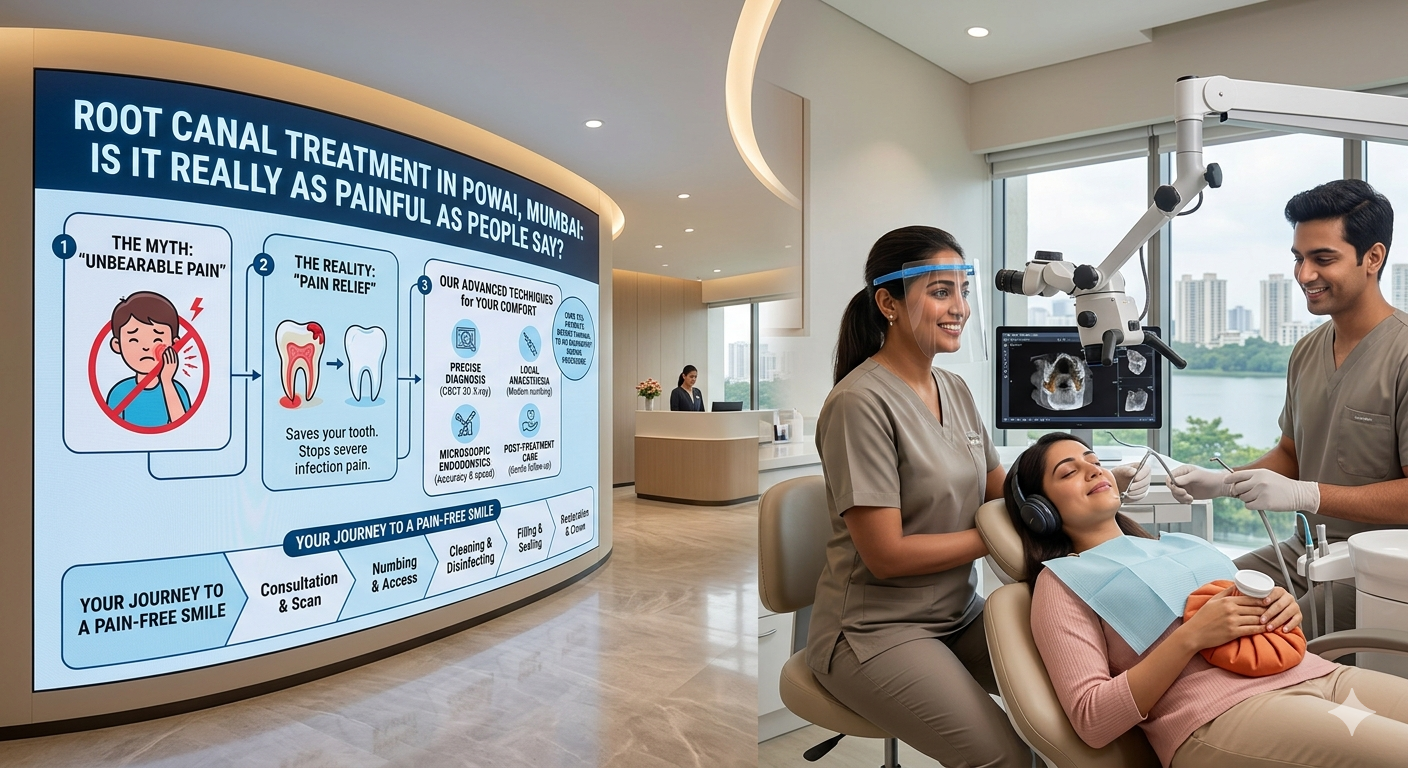
Root Canal Treatment in Powai Mumbai: Is It Really as Painful as People Say?
The moment your dentist says the words "root canal," something happens. Your stomach drops. Your hands go cold. Your brain immediately pulls up every horror story you have ever heard — the unbearable pain, the hours in the dental chair, the recovery that takes weeks.
And then you go home and Google it at midnight, which somehow makes the fear worse.
Here is the truth that dentists across Powai and Mumbai want every patient to know — the root canal treatment you are afraid of does not exist anymore.
The procedure that earned its terrifying reputation decades ago has been completely transformed by modern dentistry. Today, a root canal is no more uncomfortable than getting a simple filling. In fact, the pain you feel before a root canal — from the infected tooth — is far worse than anything you will feel during the treatment itself.
Every month, hundreds of patients walk into dental clinics in Powai Mumbai absolutely terrified, and walk out two hours later saying the same thing — "That was nothing like I expected. Why did I wait so long?"
This complete guide is written to answer every question you have been afraid to ask — what root canal treatment actually involves, why the old pain reputation is outdated, how much it costs in Mumbai, how long recovery takes, and most importantly — whether it will hurt.
Read this before your appointment. You will feel significantly better.
What Is Root Canal Treatment? Understanding the Basics
To understand root canal treatment, you first need to understand the structure of your tooth.
Each tooth has three layers:
Enamel — The hard outer surface you can see and feel.
Dentin — The middle layer beneath the enamel, slightly softer and yellowish in colour.
Pulp — The innermost soft tissue at the core of the tooth, containing nerves, blood vessels, and connective tissue. This extends down through the root canals — the narrow channels inside each tooth root.
When tooth decay is caught early, a simple filling saves the tooth. But when decay is left untreated and reaches the pulp, the pulp becomes infected by bacteria. This infection causes intense pain, sensitivity, and swelling — and it will not go away on its own.
Root canal treatment — medically known as endodontic treatment — is the procedure where the infected pulp is carefully removed, the canals are cleaned, shaped, and disinfected, and then sealed permanently to prevent reinfection. A crown is usually placed over the treated tooth to restore its full strength and function.
The result? Your natural tooth is saved. The pain is gone. You keep your smile intact.
Why Do People Think Root Canal Is Painful? The Truth Behind the Reputation
This is the most important question — and the answer has everything to do with history and nothing to do with modern dentistry.
Decades ago, dental anaesthesia was far less effective than it is today. Dentists had limited tools, and the techniques used for root canal treatment were slow, imprecise, and genuinely uncomfortable. Patients from that era passed down stories of painful experiences — to their children, their grandchildren, and anyone who would listen.
Those stories became cultural myths. Jokes about root canals became common. The fear became embedded in society — long after the actual procedure had been completely transformed.
Here is what modern root canal treatment in Powai Mumbai actually involves today:
- Advanced local anaesthesia that completely numbs the tooth and surrounding tissue before anything begins
- Rotary endodontic instruments — flexible, motorised files that clean and shape root canals in a fraction of the time compared to old manual techniques
- Digital X-rays for precise diagnosis and real-time monitoring during treatment
- Apex locators that measure the exact length of root canals electronically, eliminating guesswork
- Dental operating microscopes at advanced clinics for magnified precision
- Single sitting root canal options for eligible cases — complete treatment in one appointment
The procedure today is performed with complete comfort. Most patients feel nothing more than a slight pressure sensation during treatment. Many report falling asleep in the chair.
The real pain is the infection. The root canal removes it.
9 Signs You May Need Root Canal Treatment — Do Not Ignore These
Your tooth does not become infected overnight. It sends warning signals for weeks or months before the situation becomes critical. Here are the signs that Mumbai dentists say should never be ignored:
🚨 Sign 1: Severe, Persistent Toothache
A deep, throbbing pain that does not go away — especially pain that worsens at night when you lie down — is one of the strongest indicators of pulp infection. This type of pain cannot be controlled with painkillers alone because the source is bacterial infection deep inside the tooth.
🚨 Sign 2: Extreme Sensitivity to Hot and Cold
Normal teeth have some sensitivity. But when pain from hot or cold food and drinks lingers for 30 seconds or more after the stimulus is removed — rather than fading quickly — the pulp is likely damaged or infected.
🚨 Sign 3: Darkening or Discolouration of the Tooth
A tooth that has turned grey, dark yellow, or brown compared to surrounding teeth is often a sign that the pulp inside has died or is dying. Dead pulp tissue breaks down and stains the tooth from within.
🚨 Sign 4: Swollen or Tender Gums Near the Tooth
Swelling, redness, or a raised bump (like a pimple) on the gum near a specific tooth indicates a dental abscess — a pocket of infection that has reached the root tip. This is a dental emergency that requires immediate treatment.
🚨 Sign 5: Pain When Biting or Chewing
If a specific tooth hurts when you bite down on food — even soft food — the ligament surrounding the root is likely inflamed due to infection spreading beyond the tooth.
🚨 Sign 6: A Cracked or Chipped Tooth
A crack in a tooth — even a hairline crack you cannot see — can allow bacteria to enter and reach the pulp. Trauma from sports injuries, accidents, or biting on hard objects frequently leads to pulp infection requiring root canal treatment in Mumbai.
🚨 Sign 7: Loose Tooth in an Adult
When infection spreads from the root tip into the surrounding bone, it can soften the bone and make the tooth feel loose. A loose tooth in an adult is never normal and always requires urgent dental evaluation.
🚨 Sign 8: Facial Swelling
Swelling of the cheek, jaw, or neck alongside tooth pain indicates that the infection has spread beyond the tooth and into the surrounding tissues. This is a serious situation requiring same-day dental care.
🚨 Sign 9: Recurring Dental Abscess
If you have had an abscess in the same area before that was treated with antibiotics but keeps coming back — the source of infection inside the tooth has not been addressed. Root canal treatment eliminates the source permanently.
Step-by-Step: What Actually Happens During Root Canal Treatment in Powai Mumbai
Here is exactly what happens during your appointment — no mystery, no surprises:
Step 1 — Consultation and Diagnosis (15 Minutes)
Your dentist conducts a thorough oral examination and takes a digital X-ray of the affected tooth to assess the extent of infection, the number of root canals, and the condition of surrounding bone. This step determines whether root canal treatment is possible or if extraction is needed.
Step 2 — Local Anaesthesia (5 Minutes)
A topical numbing gel is applied to the gum first, followed by a precise injection of local anaesthetic near the affected tooth. Within 3 to 5 minutes, the entire area is completely numb. You will feel absolutely nothing during the procedure — only occasional pressure.
This is the step that changes everything for fearful patients. Once the anaesthesia works, the procedure is entirely comfortable.
Step 3 — Dental Dam Placement
A thin rubber sheet called a dental dam is placed around the tooth to isolate it from saliva and maintain a sterile working environment throughout the procedure.
Step 4 — Access Opening
Using a dental drill, a small opening is made through the top of the tooth to access the pulp chamber beneath. Because the area is completely numb, you feel nothing.
Step 5 — Pulp Removal and Canal Cleaning
Specialised instruments called endodontic files — today mostly flexible rotary files driven by a motor — are used to remove the infected pulp tissue and carefully clean and shape the inside of each root canal. Irrigation with antibacterial solutions (usually sodium hypochlorite) disinfects the canals thoroughly during this process.
Number of canals varies by tooth:
- Front teeth — 1 canal
- Premolars — 1 to 2 canals
- Molars — 3 to 4 canals
Step 6 — Canal Measurement with Apex Locator
An electronic apex locator measures the precise length of each canal to ensure complete cleaning without any infected tissue remaining. This technology has made root canal treatment significantly more accurate and predictable.
Step 7 — Canal Filling and Sealing
Once thoroughly cleaned and dried, the canals are filled with a biocompatible rubber material called gutta-percha and sealed with dental cement. This permanently seals the canals against future bacterial entry.
Step 8 — Temporary or Permanent Restoration
A temporary filling or permanent restoration is placed to close the access opening. Your dentist will schedule a follow-up appointment for crown placement.
Step 9 — Crown Placement (Separate Appointment)
A dental crown is placed over the treated tooth to restore its full biting strength and protect it from fracture. Without a crown, root canal treated teeth are significantly more vulnerable to breaking.
Total treatment time:
- Single sitting root canal (simple cases): 60 to 90 minutes
- Multi-visit root canal (complex cases or severe infection): 2 to 3 appointments
Single Sitting Root Canal in Mumbai — Is It Right for You?
One of the most frequently asked questions at dental clinics in Powai Mumbai is whether root canal treatment can be completed in a single appointment.
The answer is — yes, in many cases.
Single sitting root canal is suitable when:
- The infection is detected early before abscess formation
- The tooth has a straightforward canal anatomy
- There is no active swelling or acute abscess present
- The patient is medically fit and not on blood thinners
Multiple appointments may be needed when:
- There is a large abscess or severe infection requiring drainage first
- The canal anatomy is unusually complex (curved or extra canals)
- The infection does not respond fully after the first cleaning session
- A medicament needs to be placed between appointments to fully disinfect
Your dentist will assess your specific situation and recommend the most appropriate approach during your consultation.
Root Canal Treatment vs Tooth Extraction — The Decision That Affects Your Smile Forever
When faced with a severely infected tooth, many patients ask — why not just remove it and save the trouble?
This is understandable. But here is what you need to know before making that decision:
| Factor | Root Canal Treatment | Tooth Extraction |
|---|---|---|
| Natural tooth preserved | Yes | No |
| Biting function | Fully restored | Compromised until replaced |
| Cost | Moderate | Lower initially, higher long-term |
| Jawbone preservation | Yes | No — bone loss begins immediately |
| Adjacent teeth affected | No | Yes — teeth shift over time |
| Future treatment needed | Crown only | Implant or bridge required |
| Long-term success rate | 85 to 95 percent | Replacement success varies |
| Overall recommendation | First choice | Last resort |
The universal recommendation from dentists in Mumbai is clear — always try to save your natural tooth first.
Nothing replaces your natural tooth perfectly. A dental implant is excellent — but it is still a replacement, not your original tooth. Root canal treatment, when done by an experienced endodontist in Powai Mumbai, gives your tooth a second life with a success rate of 85 to 95 percent over 10 years.
Root Canal Treatment Cost in Mumbai — Honest and Complete Breakdown
One of the most searched questions by Mumbai patients is the cost of root canal treatment. Here is a transparent breakdown:
| Tooth Type | Approximate Cost (Mumbai) |
|---|---|
| Front Tooth (1 Canal) | ₹3,000 – ₹6,000 |
| Premolar (1–2 Canals) | ₹4,000 – ₹8,000 |
| Molar (3–4 Canals) | ₹6,000 – ₹12,000 |
| Single Sitting Root Canal | ₹5,000 – ₹10,000 |
| Root Canal + Crown | ₹10,000 – ₹25,000 |
| Retreatment (Failed RCT) | ₹8,000 – ₹15,000 |
Factors that affect root canal cost in Mumbai:
- Number of canals in the tooth
- Severity of infection
- Type of crown used (ceramic, zirconia, metal)
- Single sitting vs multiple appointments
- Clinic location and dentist experience
- Use of advanced equipment like microscopes
Always ask for a complete written treatment estimate including crown cost before beginning treatment.
Does Root Canal Treatment Hurt? — The Honest Answer from Mumbai Dentists
Let us address this directly and completely.
During the procedure: No. With modern local anaesthesia, you should feel no pain whatsoever during root canal treatment. If you feel discomfort at any point, inform your dentist immediately — additional anaesthetic can be administered. A good dentist will never proceed unless you are fully comfortable.
Immediately after the procedure: Mild soreness and sensitivity are normal for 24 to 72 hours after the anaesthesia wears off. This is not pain from the procedure itself — it is your body's natural inflammatory response as healing begins. Over-the-counter painkillers like ibuprofen or the medication prescribed by your dentist manage this very effectively.
After a few days: Most patients feel completely normal and are back to eating comfortably. The constant throbbing pain that brought them to the dentist is completely gone.
The comparison patients consistently make: The pain from the infected tooth before treatment is rated as 8 or 9 out of 10. The discomfort after root canal treatment is rated as 2 or 3 out of 10 at most — and it fades within 2 to 3 days.
Recovery After Root Canal Treatment — Complete Aftercare Guide
Proper aftercare makes a significant difference in how quickly you recover and how well the treated tooth heals.
First 24 Hours:
- Avoid eating until the anaesthesia has completely worn off to prevent accidentally biting your cheek or tongue
- Eat soft foods only — dal, khichdi, curd, mashed vegetables, and soups
- Take prescribed antibiotics and painkillers exactly as directed
- Avoid very hot or very cold beverages
- Do not chew on the treated side until the permanent crown is placed
Days 2 to 7:
- Continue with soft foods and avoid hard or crunchy items
- Brush gently around the treated area
- Rinse with warm salt water twice a day to keep the area clean
- Mild soreness should reduce noticeably by day 3
After Crown Placement:
- Avoid biting on very hard foods like bones or ice even after crown placement
- Maintain regular brushing, flossing, and 6-monthly dental checkups
- The crown should last 10 to 15 years with proper care
When to Call Your Dentist:
- Pain that worsens after 3 days instead of improving
- Swelling that increases rather than reducing
- The temporary filling falls out
- Fever develops after the procedure
- You notice the bite feels uneven after crown placement
How Long Does Root Canal Treatment Last?
This is one of the most important questions for patients investing in root canal treatment in Powai Mumbai.
A well-performed root canal treatment with a good quality crown can last a lifetime with proper oral hygiene and regular dental visits. Studies show that root canal treated teeth have a success rate of 85 to 95 percent at 10 years.
Factors that determine long-term success:
- Quality and completeness of the root canal procedure
- Type and fit of the crown placed over the tooth
- Patient's oral hygiene habits at home
- Regular professional scaling every 6 months
- Avoiding habits like teeth grinding without a mouthguard
- Prompt attention to any new symptoms if they arise
Who Performs Root Canal Treatment — Dentist vs Endodontist?
General Dentist: Can perform root canal treatment on straightforward cases — front teeth and premolars with simple canal anatomy.
Endodontist: A dental specialist with 2 to 3 years of additional training specifically in root canal procedures. Recommended for:
- Molar root canals with complex anatomy
- Retreatment of previously failed root canals
- Calcified or curved canals
- Cases with large abscesses or bone involvement
When choosing a dental clinic in Powai Mumbai for root canal treatment, always verify the experience and qualifications of the treating dentist, especially for molar root canals.
Why Choose a Dental Clinic in Powai Mumbai for Root Canal Treatment?
Powai has established itself as one of Mumbai's most medically advanced neighbourhoods. Patients across Andheri, Vikhroli, Kanjurmarg, Bhandup, and even from South Mumbai travel to Powai for quality dental care.
Choosing an experienced dental clinic in Powai Mumbai for your root canal treatment means:
- Qualified dentists and endodontists with extensive root canal experience
- Advanced rotary endodontic systems for faster, more comfortable treatment
- Digital X-rays and apex locators for precise, accurate canal measurement
- Single sitting root canal options for eligible patients
- Strict sterilisation and infection control protocols
- Transparent, all-inclusive pricing with no hidden charges
- Crown placement and complete smile restoration under one roof
- Convenient location accessible from Hiranandani, IIT Powai, Chandivali, and surrounding areas
Frequently Asked Questions (FAQs)
Q1. Is root canal treatment painful in 2025? No. With advanced local anaesthesia and modern rotary techniques, root canal treatment today is virtually painless. Most patients are surprised at how comfortable the procedure is compared to what they expected.
Q2. How many sittings does root canal treatment take in Mumbai? Simple cases can be completed in a single sitting of 60 to 90 minutes. Complex cases involving severe infection, curved canals, or multiple canals may require 2 to 3 appointments spread over 1 to 2 weeks.
Q3. What is the success rate of root canal treatment? Root canal treatment has a clinical success rate of 85 to 95 percent at 10 years when performed correctly and followed by a proper crown. With good oral hygiene, many treated teeth last a lifetime.
Q4. Can I go to work after root canal treatment? Yes. Most patients return to normal work and daily activities the same day or the following day. Avoid strenuous physical activity for 24 hours.
Q5. Is it better to get a root canal or have the tooth removed? Dentists always recommend saving your natural tooth through root canal treatment whenever possible. Extraction leads to bone loss, shifting of adjacent teeth, and requires an implant or bridge — which is ultimately more expensive and more invasive.
Q6. How much does root canal treatment cost in Mumbai? Root canal treatment costs range from ₹3,000 for a single-canal front tooth to ₹12,000 for a molar with multiple canals. Adding a crown brings the total to ₹10,000 – ₹25,000 depending on crown type and clinic.
Q7. What happens if I don't get root canal treatment? The infection will worsen, spread to surrounding teeth and bone, and may develop into a life-threatening abscess. The tooth will eventually be lost and the cost of treatment will increase significantly. Early treatment is always the better option.
Conclusion
Root canal treatment has one of the most undeserved reputations in all of medicine. Decades of outdated stories, dental jokes, and fear passed down through generations have made people avoid a procedure that could save their tooth — and sometimes their health.
The truth is simple. Root canal treatment in Powai Mumbai today is safe, comfortable, predictable, and effective. The technology is advanced. The anaesthesia is excellent. The results last decades. And the alternative — losing your natural tooth — carries far greater consequences in terms of health, appearance, and long-term cost.
If you have been experiencing tooth pain, sensitivity, swelling, or any of the signs discussed in this blog — do not wait. Do not let fear make a decision that your dentist should be making with you.
Walk into a trusted dental clinic in Powai Mumbai. Get your tooth examined. Ask every question you have. And let an experienced dentist give you the honest, personalised guidance you deserve. The tooth you save today m
ay be the smile you carry for a lifetime.
Book your root canal consultation in Powai Mumbai today — and take the fear out of the equation for good.