


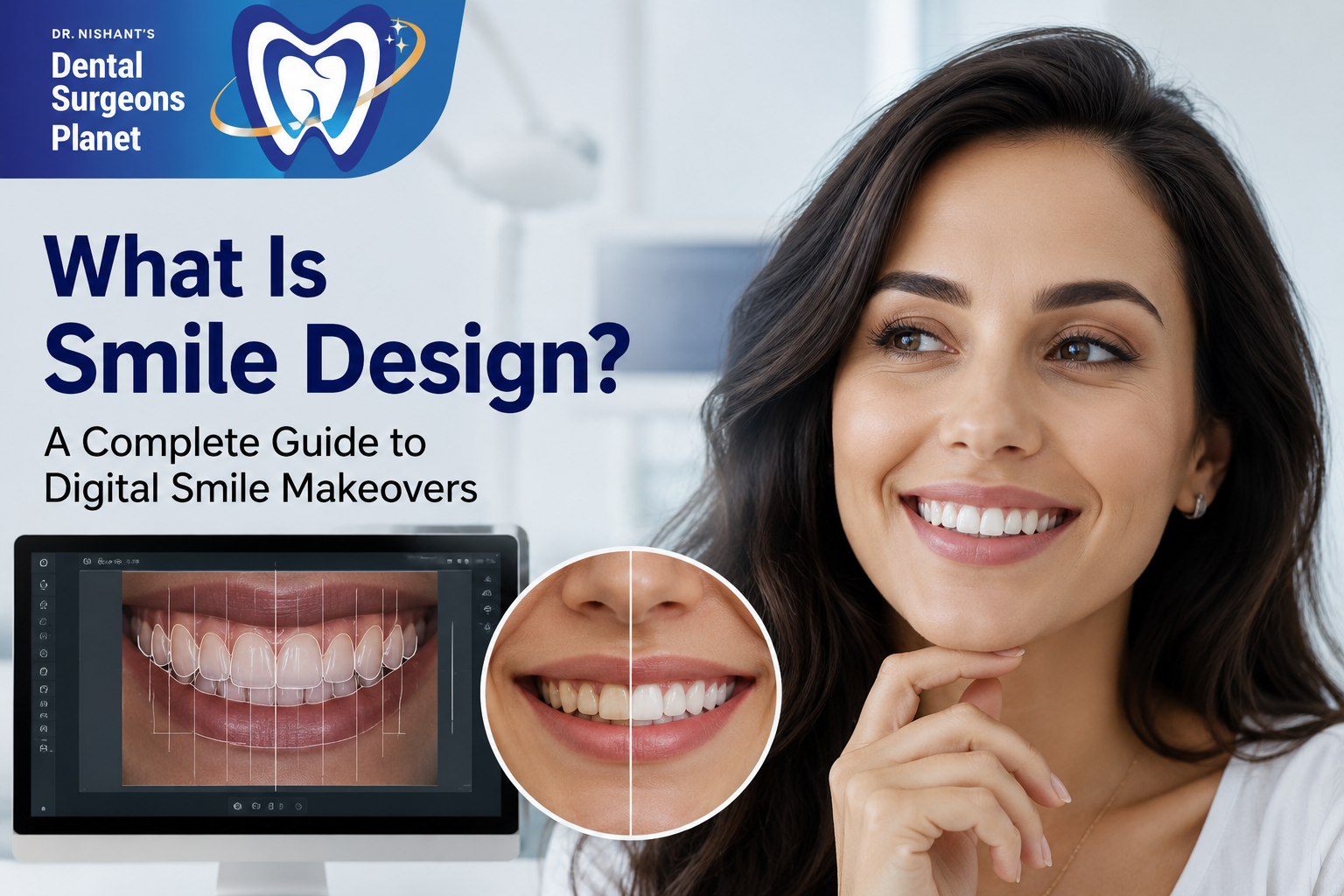
What Is Smile Design? A Complete Guide to Digital Smile Makeovers
The phrase smile design gets used a lot in dental marketing — on clinic websites, social media posts, and before-after photo galleries. But very few of these sources actually explain what smile design means clinically, how the process works from consultation to completion, or why two patients with similar-sounding concerns can end up with completely different treatment plans under the same label.
If you have been researching smile makeovers in Powai Mumbai and found yourself more confused after reading about it than before — this guide is written specifically for you.
Smile design is not a single procedure. It is not teeth whitening with a fancier name. It is not something every dentist offering cosmetic treatment is equally equipped to deliver. And it is certainly not a one-size-fits-all process where every patient gets the same bright white result regardless of their face, their age, or their starting point.
This guide explains what smile design actually is, how digital smile design works, which treatments are involved, what makes a genuinely good outcome versus a result that looks artificial, who the right candidates are, and what the complete process looks like from your first consultation to your final result in Powai Mumbai.
What Is Smile Design? The Clinical Definition
Smile design — also called a smile makeover — is a comprehensive cosmetic dental process in which a qualified cosmetic dentist analyses and improves the appearance of a patient's smile through a planned combination of treatments, designed specifically around the individual's facial features, dental anatomy, functional requirements, and personal aesthetic preferences.
The word comprehensive is the key distinction. Smile design is not about improving one element of the smile in isolation. It considers the complete picture — how the teeth relate to the lips, the gum line, the facial midline, the proportions of the face, and how the smile looks in motion when the patient speaks and laughs — not just in a static photograph.
A well-designed smile looks like it has always belonged to that person's face. A poorly designed one looks like an obvious cosmetic intervention — overly white, uniformly shaped teeth that look staged rather than natural. The difference between these two outcomes is the quality of the analysis and planning that happens before any treatment begins.
The Principles That Guide Good Smile Design
Understanding what cosmetic dentists in Powai Mumbai assess during smile design planning helps you understand why the process is more involved than simply whitening teeth or bonding a chip.
Facial proportions
The smile must be proportionate to the face. The width of the smile, the length of the teeth, and the visible gum when smiling all need to work within the patient's specific facial dimensions. A smile designed for a narrow face looks wrong on a broader one — and vice versa.
The golden proportion
A principle from aesthetic theory applied to cosmetic dentistry — the width of each tooth should relate proportionally to the tooth beside it in a specific mathematical ratio that the human eye perceives as naturally pleasing. Good smile design applies this principle while accounting for individual anatomy rather than imposing it rigidly.
Tooth colour
The appropriate shade of white is not the same for every patient. A very bright, blue-white result looks natural on some patients and completely artificial on others. Age, skin tone, hair colour, and personal preference all inform the target shade. A cosmetic dentist who gives every patient the same shade of white is not designing — they are applying a formula.
Gum line symmetry
The gum line frames the teeth the way a picture frame affects a painting. An uneven, asymmetric, or excessively visible gum line affects the entire appearance of the smile regardless of how well the teeth themselves are shaped and coloured.
Midline alignment
The centre line between the two upper front teeth should ideally align with the centre of the face. Even slight misalignment creates a subtle but persistent sense that something is off — even if the observer cannot identify exactly what.
Lip dynamics
How much tooth shows when smiling, the relationship between the upper lip and the gum line, and how the smile looks when the patient laughs rather than poses — all of these are assessed because a smile exists in motion, not only in photographs.
What Is Digital Smile Design?
Digital smile design — often abbreviated as DSD — is a planning methodology that uses digital photography, video, and specialised software to analyse a patient's facial and dental proportions and create a visual simulation of the proposed treatment outcome before any procedure begins.
Here is how the digital smile design process works at a cosmetic dental clinic in Powai Mumbai:
Step 1 — Comprehensive documentation
High-resolution photographs of the face at rest, smiling, and in profile. Close-up photographs of the teeth from multiple angles. Video of the patient speaking and smiling naturally. In advanced setups, intraoral digital scans replace physical impressions entirely.
Step 2 — Digital analysis
The photographs are imported into smile design software where facial reference lines — the horizontal plane, facial midline, lip line, and smile arc — are mapped precisely onto the face. This creates a framework within which the proposed tooth proportions and positions are designed.
Step 3 — Treatment simulation
The proposed result is designed digitally — showing exactly how the teeth will look after the planned treatments in the context of the patient's actual face, lips, and gum line. This is not a generic rendering. It is a patient-specific simulation based on their real photographs.
Step 4 — Patient review and feedback
The patient sees their simulated result on screen and gives feedback. Shade adjustments, length changes, gum line modifications — all of these can be shown digitally before any clinical decision is finalised. The patient approves the design before treatment planning is confirmed.
Step 5 — Mock-up
In many cases, a physical mock-up is created — a temporary version of the proposed veneers or restorations placed over the patient's existing teeth using composite material so the patient can see, feel, and experience the result in real life before any irreversible treatment is done. This step removes virtually all uncertainty from the outcome.
Digital smile design transformed cosmetic dentistry because it moved the patient from passive recipient to active participant in their own treatment. You no longer need to trust a description of what your smile will look like — you see it before committing.
Treatments Included in Smile Design
Smile design is a plan, not a procedure. The treatments that make up the plan depend entirely on what each patient's smile needs. Here is what the full toolkit looks like:
Teeth whitening
The foundation of almost every smile makeover. Professional in-clinic whitening removes deep staining and creates the base shade from which other cosmetic work is planned. Whitening is always done first because it determines the shade target for any restorations being placed.
Dental veneers
Porcelain or composite veneers are the most powerful tool in smile design. Ultra-thin shells bonded to the front surface of teeth correct colour, shape, size, surface texture, minor gaps, and chips simultaneously — with results that are both transformative and entirely natural-looking when designed correctly.
Porcelain veneers require two appointments and laboratory fabrication. They last 10 to 15 years and have the most natural light-reflecting properties of any restorative material.
Composite veneers are placed directly on the tooth in a single appointment. They last 5 to 7 years, cost less, and are an excellent option for patients who want significant improvement at a more accessible price point.
Gum contouring
The gum line is as important to the smile as the teeth themselves. Laser gum contouring precisely reshapes and symmetrises the gum margin — correcting a gummy smile, an uneven gum line, or asymmetric gum levels around specific teeth. The laser seals as it cuts, meaning minimal bleeding and fast recovery.
Composite bonding
Tooth-coloured resin sculpted directly onto teeth to close small gaps, repair chips, adjust minor shape irregularities, and add length to slightly short teeth. A conservative, reversible option for targeted corrections that does not require enamel removal.
Dental crowns
Where teeth are too damaged, discoloured, or structurally compromised for veneers to address adequately, ceramic or zirconia crowns restore full form and function while matching the surrounding smile aesthetics precisely.
Orthodontic alignment
When tooth position affects the smile significantly — crowding, rotation, spacing — Invisalign or braces may be recommended before cosmetic treatment so that veneers and bonding are placed on properly positioned teeth for a stable, long-lasting result.
Dental implants
Missing teeth create gaps that affect smile symmetry and proportion. Where missing teeth are part of the smile design area, implants with ceramic crowns restore the complete smile before or alongside other cosmetic treatments.
Who Is the Right Candidate for Smile Design?
This is one of the most important questions to answer honestly — because not every patient who wants a smile makeover is ready for one, and not every patient who needs one realises it.
Good candidates for smile design
Patients with healthy gums and no active dental disease. Existing infections, gum disease, and cavities are treated first — cosmetic work built on an unhealthy foundation fails faster and creates more problems than it solves.
Patients with realistic expectations. Smile design can achieve extraordinary results — but results that suit the individual face and dental anatomy. A patient who arrives with a photograph of a celebrity's smile and wants that exact result regardless of their own features needs honest guidance rather than compliance.
Patients who understand the maintenance requirements. Veneers and cosmetic restorations require proper care, regular dental visits, nightguards if grinding is present, and avoidance of habits like nail biting and opening packaging with teeth. Patients committed to this maintenance see results that last decades.
Patients who need preparation before smile design
Active gum disease must be fully treated and stable before any cosmetic treatment begins. Patients who grind their teeth significantly need a nightguard and ideally a period of grinding management before porcelain veneers are placed, as grinding generates forces that can fracture veneers.
Patients with significant misalignment benefit from orthodontic treatment before veneers so that the cosmetic restorations are placed in optimal positions rather than compensating for tooth position with thicker or more angled veneers.
What Makes a Smile Design Look Natural vs Artificial
This question comes up consistently at consultations with cosmetic dentists in Powai Mumbai — and it is one of the most important considerations in planning.
Why some smile makeovers look artificial
Shade that is too bright or too uniform. Natural teeth have translucency — light passes through the edges and creates depth and variation. A flat, opaque, uniformly bright result looks like a cosmetic intervention rather than a real smile.
Teeth that are too long, too wide, or too symmetrical for the patient's face. Perfect mathematical symmetry does not exist in nature and the human eye detects it as artificial. Slight natural asymmetry in a well-planned smile actually looks more real than geometric perfection.
Gum line not addressed alongside tooth work. Veneers on uneven gum margins look like expensive work applied without considering the complete frame.
What makes a smile look genuinely natural
Appropriate shade selection that considers skin tone, age, and translucency matching surrounding natural teeth. Individualised tooth shapes that reference the patient's original dental anatomy rather than a standard template. Gum contouring that completes the frame. And a planning process — like digital smile design — that involves the patient in approving the result before execution.
Smile Design Cost in Powai Mumbai
| Treatment Component | Approximate Cost |
|---|---|
| Digital smile design consultation | ₹500 – ₹1,500 |
| Professional teeth whitening | ₹3,000 – ₹15,000 |
| Composite veneers per tooth | ₹3,000 – ₹8,000 |
| Porcelain veneers per tooth | ₹10,000 – ₹20,000 |
| Laser gum contouring | ₹5,000 – ₹15,000 |
| Composite bonding per tooth | ₹2,000 – ₹6,000 |
| Zirconia crown per tooth | ₹8,000 – ₹15,000 |
| Complete smile makeover | ₹30,000 – ₹2,00,000+ |
The range is wide because smile design varies from a two-treatment whitening and bonding plan to a comprehensive multi-treatment makeover involving multiple veneers, gum work, and alignment. Your written treatment plan after consultation will include a precise cost breakdown for your specific case.
How to Choose the Right Cosmetic Dentist for Smile Design in Powai Mumbai
The outcome of smile design depends more on the dentist performing it than on any other single factor. Here is what to assess before committing:
MDS qualification in relevant specialisation
Look for an MDS in Prosthodontics, Conservative Dentistry, or Oral Rehabilitation. These postgraduate qualifications cover the depth of knowledge that smile design planning and execution require.
Real patient portfolio
Ask to see before-and-after photographs of actual patients treated at that clinic — not stock photography from veneer manufacturer websites. Look for variety in the cases shown. A dentist confident in their results will show real work without hesitation.
Digital smile design capability
A clinic that shows you your expected result before treatment begins is one that plans properly. Absence of this step means either the technology is not available or the planning depth is insufficient for the level of investment smile design represents.
How the consultation feels
A cosmetic dentist invested in your outcome asks about your preferences, explains the options and their trade-offs, is honest about what is achievable and what is not, and does not rush toward the most expensive option before thoroughly understanding your situation. The quality of the consultation predicts the quality of the treatment.
FAQs
Q1. How is smile design different from simply getting veneers?
Veneers are one tool within smile design. Smile design is the complete planning process — analysing facial proportions, gum line, tooth colour, alignment, and function — and then selecting the right combination of treatments, which may or may not include veneers, to achieve a harmonious result. Veneers without smile design planning can deliver technically good restorations that do not suit the individual face.
Q2. How many teeth are typically included in a smile makeover?
This varies entirely by individual case. Some patients need only four to six front teeth addressed for a complete visual improvement. Others benefit from treating eight to ten teeth for symmetry across the full visible smile. Your cosmetic dentist will recommend the minimum number of teeth needed to achieve a harmonious result — not the maximum.
Q3. Is smile design permanent?
Porcelain veneers last 10 to 15 years. Composite veneers last 5 to 7 years. Gum contouring results are permanent. Whitening results last 1 to 3 years and can be maintained with touch-up treatments. No cosmetic dental treatment is permanent in the sense of lasting forever unchanged, but well-maintained smile design delivers long-lasting results.
Q4. Does smile design require removing tooth structure?
Porcelain veneers require minimal enamel reduction — typically 0.3 to 0.5mm from the front surface of the tooth — which is irreversible. Composite bonding and composite veneers are additive and minimally invasive, sometimes requiring no enamel removal at all. Your cosmetic dentist will discuss exactly what each recommended treatment involves for your specific teeth.
Q5. Can I get smile design if I have missing teeth?
Yes — but missing teeth are typically addressed first, either with implants or by incorporating the space management into the overall plan. A smile design that does not account for gaps in the smile cannot achieve a complete result.
Q6. How long does the complete smile design process take from consultation to final result?
Simple smile makeovers — whitening and composite bonding — can be completed in one to two appointments over a week. Comprehensive plans involving porcelain veneers, gum contouring, and possibly orthodontic preparation typically take 4 to 12 weeks depending on the number of treatments involved and whether preparatory work is needed first.
Conclusion
Smile design is one of the most personalised, technically involved, and genuinely life-changing treatments that cosmetic dentistry offers. When done well — by a qualified cosmetic dentist using proper digital planning, appropriate shade selection, and an honest assessment of what suits the individual face — it delivers results that look entirely natural and last for years.
When done poorly — without proper planning, without patient involvement in the design, without considering facial proportions — it delivers the artificial, uniform, instantly identifiable cosmetic-dental look that gives the entire field an unfair reputation.
The difference between these two outcomes is the dentist and the process. Choosing a cosmetic dentist in Powai Mumbai with an MDS qualification, a genuine patient portfolio, digital smile design capability, and the clinical honesty to tell you what will actually work for your face is the decision that determines your result.
Book your smile design consultation at Dental Surgeons Planet in Powai Mumbai today. See your new smile digitally before a single treatment begins — and make an informed decision about the most personalised cosmetic dental investment you will ever make.
Your smile was designed to be seen. Let us design it properly.